Silverado 1500 Tongue Weight and Hitch Class, Documented
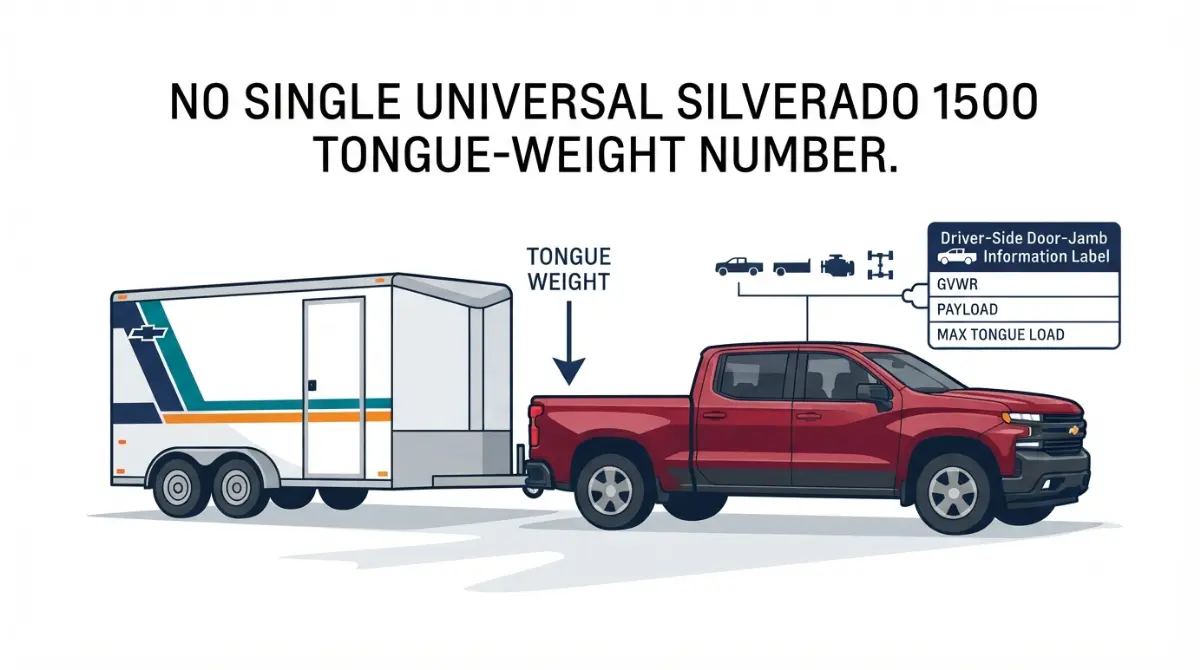
Table of Contents
Max tongue weight on a Silverado 1500: the short answer
There isn’t one. Chevrolet publishes no single tongue weight figure for the Silverado 1500; the limit is printed on a label inside each truck’s driver-side door jamb, and it changes with the build.
What this page covers
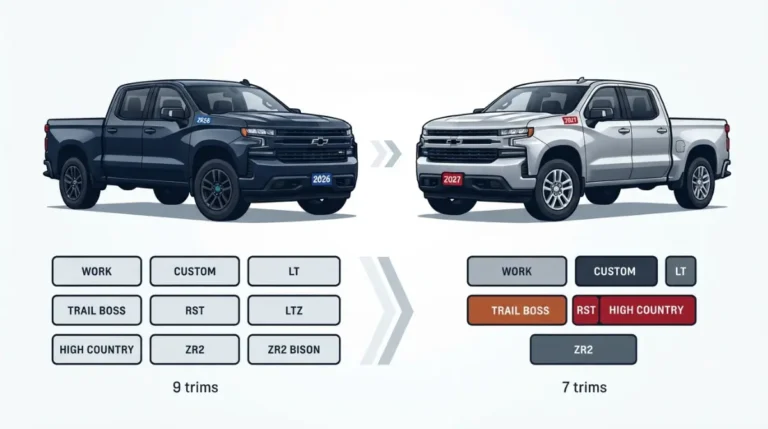
This page covers model years 2024 and 2026, checked against Chevrolet’s trailering guides. The next-generation 2027 truck gets its own section because its tongue weight and hitch data aren’t published yet.
Where to jump
- Sizing a trailer: start at the ceiling table.
- Matching a hitch: go to the hitch class section.
- Cross-shopping builds or years: see the 2024–2027 comparison.
- First time towing: read the last section first.
ℹ️ Safety Note: Tongue weight and hitch ratings affect braking and stability, and a load beyond a rated limit is a control problem, not just a performance one. The figures here are for comparison. Verify against the door-jamb label and owner’s manual for your exact truck before buying a trailer or hitch.
📍 Check your own vehicle first: Specifications vary by build date, package and market, and two trucks with the same badge can be built differently. Before you buy anything based on this page, confirm against the Trailering Information Label on the driver-side door jamb and the trailering section of your owner’s manual. If your vehicle disagrees with this page, your vehicle is right.
The 10–15% rule and the 10% ceiling at max rating
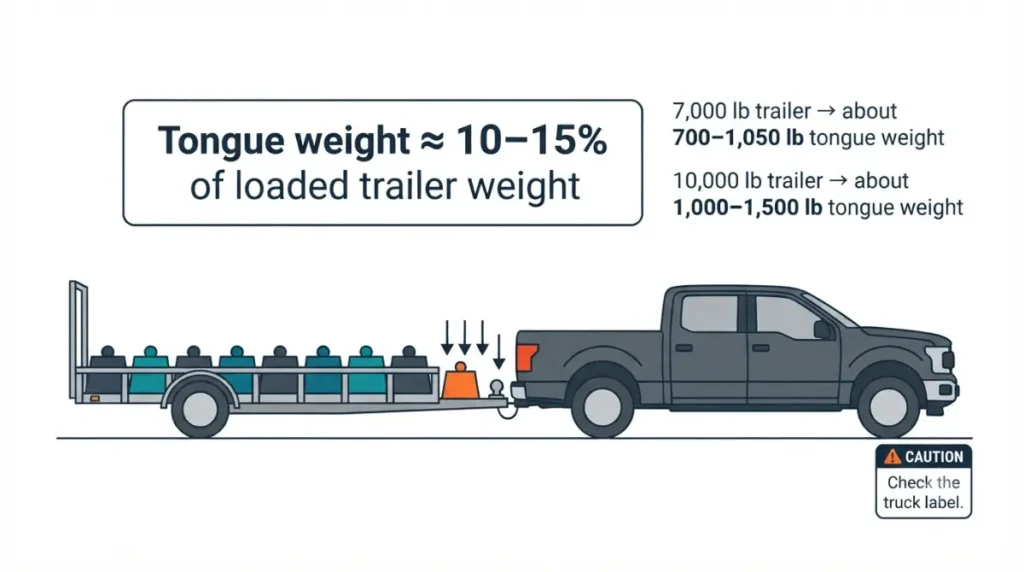
Chevrolet’s 2026 trailering guide states tongue weight as a share of loaded trailer weight: 10% to 15% for conventional trailers and 15% to 25% for gooseneck or fifth-wheel kingpin weight on the Silverado 1500.
Conventional: 10–15% of loaded trailer weight
Boat trailers and some others fall outside that range; follow the trailer’s own manual then.
📐 On the Spec Sheet: Chevrolet’s 2026 and 2024 guides: at maximum trailer weight, maximum tongue weight is 10% (conventional) or 15% (gooseneck/fifth-wheel), Silverado 1500.
Gooseneck/5th-wheel: 15–25% of loaded trailer weight
Kingpin load sits near the rear axle, so Chevrolet says to watch payload and rear axle rating; the hitch mounts to the frame, not the bed. See ratings by engine in our Silverado 1500 towing capacity by engine guide.
Tongue weight ceiling by Silverado 1500 configuration
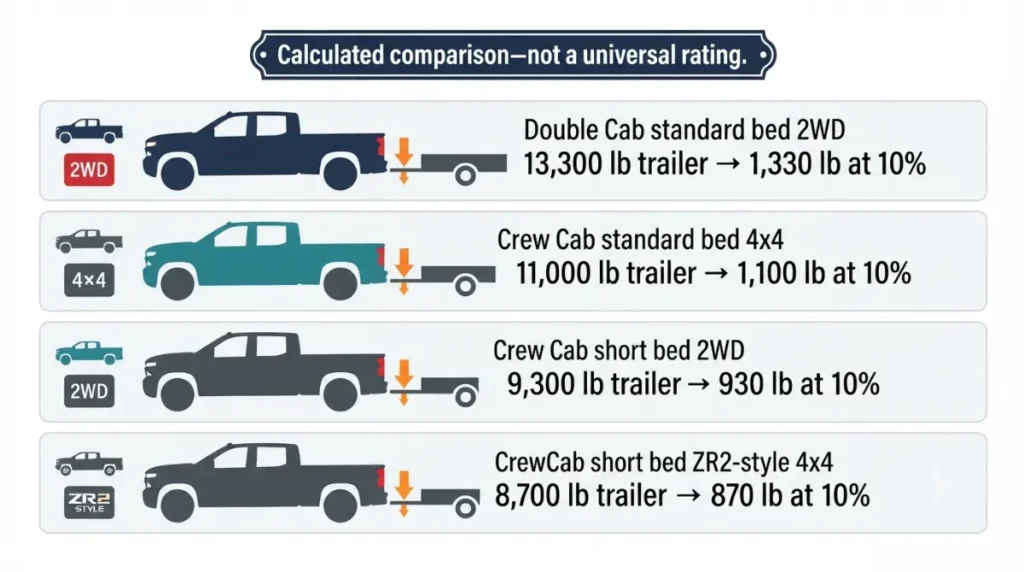
Applying Chevrolet’s 10% statement to each build’s maximum trailer rating gives a tongue weight ceiling.
| Applies To (MY2026) | What It Includes | GCWR (lb) | Max trailer (lb) | 10% figure (lb) |
|---|---|---|---|---|
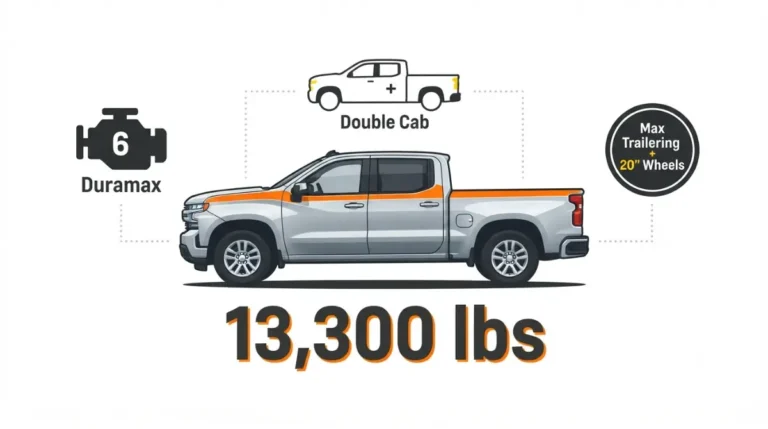
| Double Cab, Standard Bed, 2WD | Duramax 3.0L, Max Trailering Package, 20″ wheels | 19,000 | 13,300 | 1,330 |
| Crew Cab, Standard Bed, 4×4 | 5.3L V8, Max Trailering Package | 16,800 | 11,000 | 1,100 |
| Crew Cab, Short Bed, 2WD | TurboMax | 14,500 | 9,300 | 930 |
| Crew Cab, Short Bed ZR2, 4×4 | Duramax 3.0L | 15,000 | 8,700 | 870 |
Source: Chevrolet 2026 Trailering Guide, pp. 26–27. The 10% figure is calculated (max trailer × 0.10), not a Chevrolet-published rating; Chevrolet publishes ratings for comparison only.
Gooseneck and fifth-wheel lines
Gooseneck: 10,300 lb for the 2026 Double Cab Standard Bed 2WD 5.3L V8 with Max Trailering Package (15% is 1,545 lb); 6,000 lb for the Crew Cab Short Bed ZR2 4×4 (900 lb).
Why your truck’s number can be lower
⚠️ Watch Out: These ceilings aren’t permission to load that much. Added tongue weight must not exceed the truck’s rear axle rating, GVWR or Max Trailer Tongue Load, and any can limit you first. If your label shows less, the label wins.
See the full Silverado 1500 configuration matrix for more builds.
Hitch class: what Chevrolet says and doesn’t say
Chevrolet’s trailering guide sorts trailers into five classes by loaded weight, and its Silverado 1500 pages name no receiver class.
Chevrolet’s trailer classes I–V
📐 On the Spec Sheet: Chevrolet’s 2026 guide: Class I up to 2,000 lb gross trailer weight; II 2,001–3,500; III 3,501–5,000; IV 5,001–10,000; V 10,001 and above. These classify trailers, not receivers.
Why a Class IV receiver doesn’t raise your limit
🚫 Fits But Shouldn’t: A receiver rated above the truck’s limit doesn’t raise it. Chevrolet caps added tongue weight at the truck’s rear axle rating, GVWR and Max Trailer Tongue Load, so compare the label, the receiver’s published rating and the ball’s, and respect the lowest.
The ball must meet or exceed the trailer’s gross weight rating, and a required weight-distributing hitch must be frame-mounted with sway control. The Silverado 1500 sections of both guides give no weight at which one is required.
Tongue weight counts against payload and rear axle
Tongue weight rests on the truck, so it competes with passengers and cargo for the truck’s own capacity.
Tongue weight and GVWR
Chevrolet says GVWR must be at least the truck’s weight plus passengers, cargo and tongue weight.
🔍 What This Spec Means: Payload isn’t only bed cargo. People, gear and tongue weight all count against it, so a full cab leaves less for the hitch than a maximum payload figure suggests.
What the door label gives you
The Trailering Information Label lists GVWR, GCWR, rear axle rating, maximum payload, maximum tongue weight and curb weight. For payload by build, see our Silverado 1500 payload capacity by configuration guide.
2024, 2026 and 2027: why last year’s number may be wrong
Chevrolet revises ratings between model years.
2024 vs 2026: same builds, different numbers
The Double Cab Standard Bed 2WD with the 5.3L V8 went from 9,600 lb in the 2024 guide to 9,700 lb in 2026. The Crew Cab Short Bed ZR2 4×4 Duramax gooseneck rating went from 6,200 lb to 6,000 lb.
2027: what GM has and hasn’t published
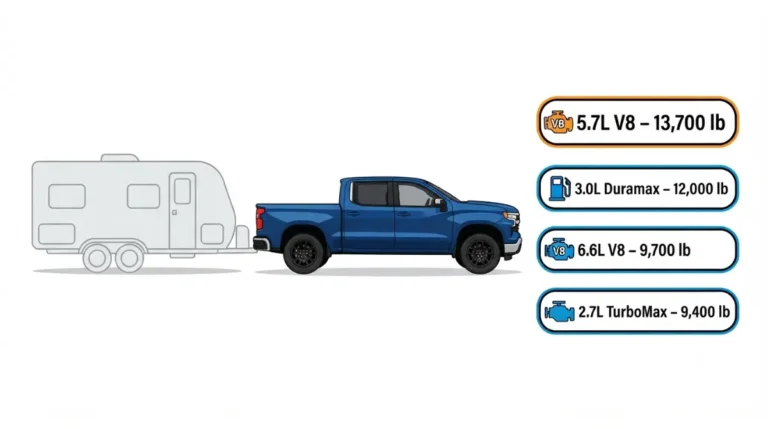
📐 On the Spec Sheet: GM’s Sept. 17, 2026 release lists 2027 Silverado 1500 maximum towing of 13,700 lb (5.7L V8), 12,000 lb (Duramax 3.0L), 9,700 lb (6.6L V8) and 9,400 lb (Enhanced TurboMax), varying by configuration, trim and packages.
It gives no tongue weight, hitch class or per-configuration data, so don’t carry this page’s 2026 ceilings to 2027. See our 2027 Silverado 1500 towing capacity page for the new lineup.
Where to confirm your exact limit before you buy
Everything above ends at the same two labels.
The Trailering Information Label
- Find the Trailering Information Label on the driver-side door jamb.
- Compare its maximum tongue weight with the trailer’s rated hitch weight.
The certification label
The certification label on the driver door or doorframe lists rear axle rating and GVWR. For an unbought truck, ask the dealer to read both off the exact vehicle.
✅ Do This: Before paying for a trailer or hitch, ask: “What do the labels on this exact truck say for maximum tongue weight, maximum payload and rear axle rating?” Write all three down.
Silverado 1500 tongue weight FAQ
1. What is the max tongue weight for a Silverado 1500?
Chevrolet publishes no single Silverado 1500 tongue weight; each truck’s limit is on its door-jamb Trailering Information Label. Read that label first.
2. What percent of trailer weight should Silverado 1500 tongue weight be?
Chevrolet’s Silverado 1500 tongue weight guidance is 10% to 15% of loaded trailer weight for conventional trailers. Boat trailers can fall outside it.
3. What is Silverado 1500 tongue weight at the maximum trailer rating?
At maximum trailer weight, Chevrolet puts Silverado 1500 tongue weight at no more than 10% for conventional trailers and 15% for gooseneck. Confirm your label.
4. What is Silverado 1500 kingpin weight for a gooseneck?
Chevrolet puts gooseneck and fifth-wheel kingpin weight at 15% to 25% of loaded trailer weight on the Silverado 1500, within payload and rear axle limits.
5. Does a Class IV hitch raise Silverado 1500 tongue weight limits?
No. Chevrolet’s Silverado 1500 tongue weight cannot exceed the truck’s rear axle rating, GVWR or Max Trailer Tongue Load, whatever the receiver is rated. Check the label and the receiver maker’s rating.
6. Where is the Silverado 1500 tongue weight limit listed?
The Silverado 1500 tongue weight limit is on the Trailering Information Label on the driver-side door jamb, alongside GVWR, GCWR and payload.
7. Does tongue weight reduce Silverado 1500 payload?
Yes. Chevrolet says GVWR must cover the truck, passengers, cargo and tongue weight, so Silverado 1500 tongue weight counts against payload.
8. Do I need a weight-distributing hitch on a Silverado 1500?
Chevrolet’s Silverado 1500 pages give no trailer or tongue weight threshold; if a trailer requires one, use a frame-mounted hitch with sway control. Check your owner’s manual.
9. Is 2027 Silverado 1500 tongue weight the same as 2026?
2027 Silverado 1500 tongue weight isn’t published yet; GM’s announcement lists engines, maximum towing and payload only, so don’t carry 2026 figures over.
10. Does every Silverado 1500 reach the maximum trailer rating?
No. Silverado 1500 tongue weight limits follow cab, bed, drivetrain, engine and package; 2026 conventional ratings run from 8,700 to 13,300 lb.
Match the trailer to the label, not the headline
A Silverado 1500’s tongue weight limit lives on that truck’s door-jamb label, not in a rule of thumb or a headline tow rating. Read the label on the exact truck, compare it with the trailer’s rated hitch weight, and run the numbers in our Payload & Tongue Weight Calculator before you buy a trailer or hitch.