Documented Silverado vs F150 vs Ram Payload by Engine and Drive
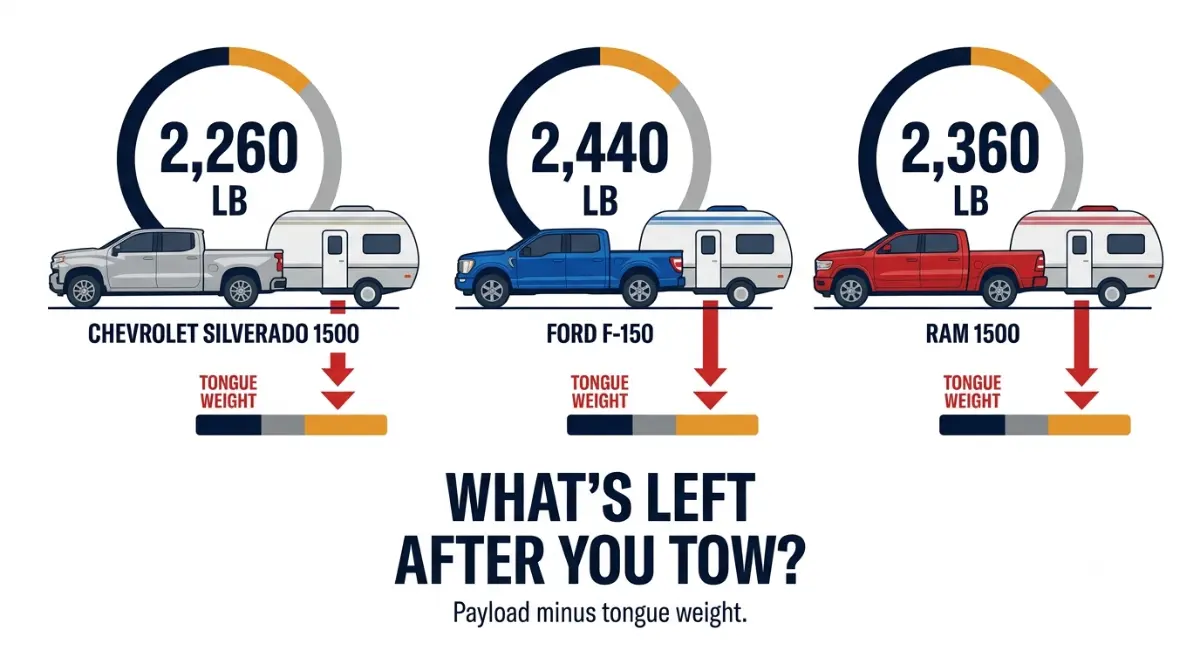
Table of Contents
Silverado vs F-150 vs Ram payload: what’s left after you tow?
Payload isn’t one number on these trucks; each 2026 ceiling belongs to one engine, drivetrain and cab. Comparing trucks? Start with the first table. Sizing a trailer? Go to the tongue-weight math. Tow ratings alone are in F-150 vs Silverado vs Ram towing, and the Silverado 1500 specs by configuration guide has the rest. The 2027 Silverado changes engines; see its towing ratings.
ℹ️ Safety Note: Payload and tow limits govern braking, steering and stability. Confirm your truck’s payload, GVWR and rear axle rating on its labels before loading or hitching.
📍 Check your own vehicle first: Specifications vary by build date and package. Confirm against your door-jamb labels and owner’s manual; if your vehicle disagrees, your vehicle is right.
Max payload by engine, and the build behind it
| Truck | Engine and build | Max payload (lb) | Applies To |
|---|---|---|---|
| Ford F-150 | 3.5L EcoBoost, 4×2 | 2,440 | 2026 engine maximum |
| Ford F-150 | 3.5L EcoBoost, 4×4 | 2,175 | 2026 engine maximum |
| Ram 1500 | 3.6L V6, Quad Cab 4×2 | 2,360 | 2026 |
| Ram 1500 | 3.0L Hurricane SO, Quad Cab 4×2 | 1,930 | 2026 |
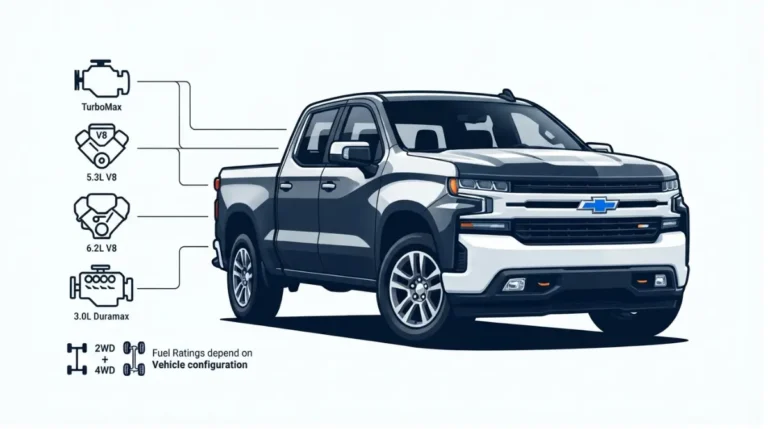
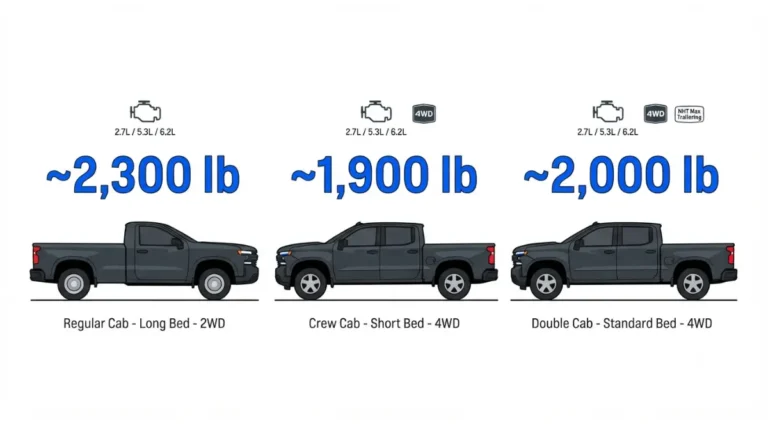
| Silverado 1500 | 2.7L TurboMax, Regular Cab Long Bed 2WD | 2,260 | 2026 |
Sources: Ford 2026 F-150 Technical Specifications; Ram 2026 1500 Payload & Towing sheet. Silverado is Chevrolet’s marketed maximum; GM’s trailering documents carry no payload column.
📐 On the Spec Sheet: Ford’s 2026 F-150 technical specifications list payload separately for 4×2 and 4×4. Applies To: 2026 F-150.
Other Silverado builds are in Silverado 1500 payload by cab, bed and engine.
Tow vs payload: the builds that max one don’t max the other
| Build | Max tow (lb) | Payload (lb) | Applies To |
|---|---|---|---|
| F-150 3.5L EcoBoost, 4×4 | 13,500 | 2,175 | 2026 SuperCrew; Max Tow Axle |
| F-150 3.5L EcoBoost, 4×2 | 13,300 | 2,440 | 2026 SuperCrew; Max Tow Axle |
| Ram Quad Cab 4×2, 3.6L V6 | 8,130 | 2,360 | 2026; 3.55 axle |
| Ram Quad Cab 4×2, Hurricane SO | 11,610 | 1,930 | 2026; 3.92 axle, GCWR 17,000 |
| Silverado Regular Cab Long Bed 2WD, 2.7L | 9,500 | 2,260 | 2026 |
Sources: Ford 2026 Technical Specifications; Ram’s 2026 payload and towing sheet; Chevrolet’s 2026 trailering guide for the 9,500 lb tow rating.
🚫 Fits But Shouldn’t: An F-150 ordered for its 13,500 lb tow rating is a 4×4 with a 2,175 lb payload ceiling, not the 2,440 lb 4×2 figure.
How much payload is left once the trailer is hitched?
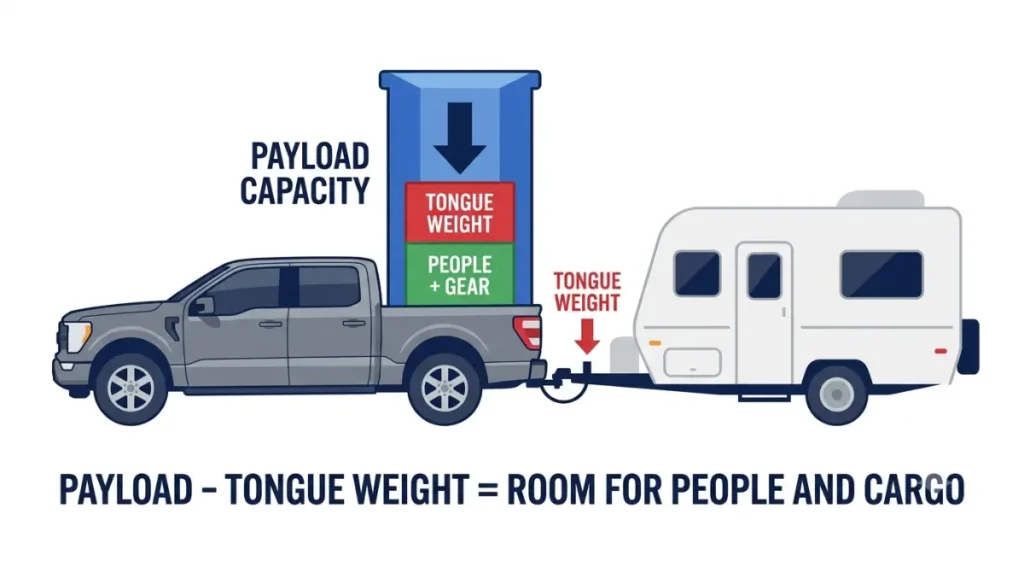
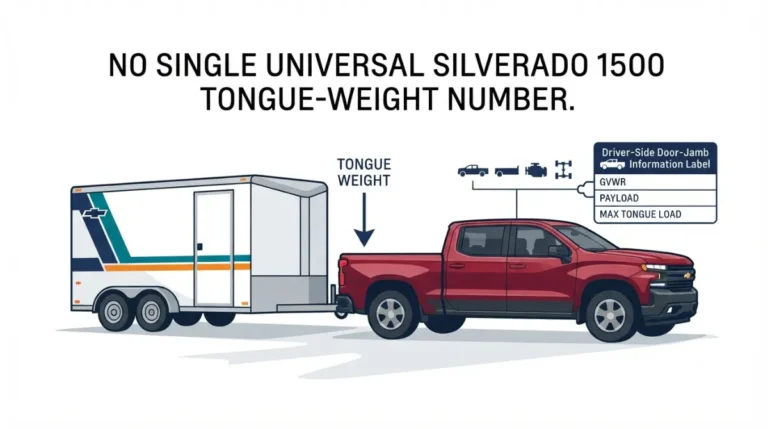
Tongue weight, the trailer’s load on the hitch, comes out of payload.
| Build (2026) | Tongue load at max rating | Payload ceiling | Left before people and gear |
|---|---|---|---|
| F-150 3.5L SuperCrew 4×4, 13,500 lb | 1,350 lb (10%) | 2,175 lb | 825 lb at most |
| Ram Hurricane SO Quad Cab 4×2, 11,610 lb | 1,100 lb (cap; 10% is 1,161) | 1,930 lb | 830 lb at most |
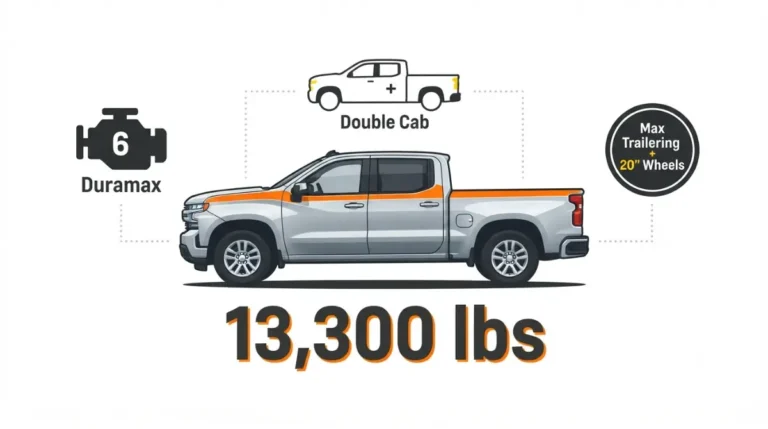
| Silverado Duramax Double Cab 2WD, 13,300 lb | 1,330 lb (10%) | Not in GM’s tow chart | Read your label |
Derived by subtraction, not a maker statement. Sources: Ford’s 2026 towing guide, Ram’s sheet, Chevrolet’s 2026 trailering guide.
🔍 What This Spec Means: NHTSA’s interpretation defines load carrying capacity as GVWR minus unloaded weight, so people, cargo and tongue weight share one pool.
✅ Do This: Have the dealer read payload and tongue weight off your VIN’s label, then run your loads through the Payload & Tongue Weight Calculator.
What uses up payload before you load the bed
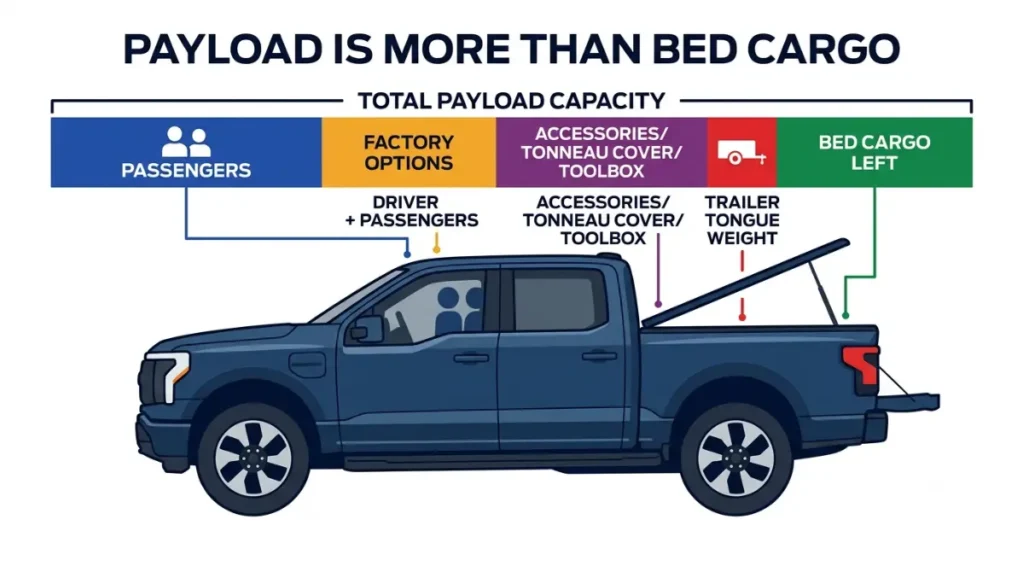
- Occupants. NHTSA’s GVWR rule counts 150 lb per seating position. Tow ratings assume about 300 lb: GM counts 150 lb each for driver and front passenger, and Ram states 300 lb.
- Four-wheel drive. On Ford’s 2026 engines, 4×4 lowers max payload by 60 to 305 lb, depending on engine.
- Options. Ford says to reduce payload by option weight.
What each trade costs: payload against tow
| Trade (2026) | Tow change | Payload change |
|---|---|---|
| F-150 3.5L, 4×2 to 4×4 | +200 lb | −265 lb |
| Ram Quad Cab 4×2, V6 to Hurricane SO | +3,480 lb | −430 lb |
Derived from the Ford and Ram figures above. These are costs, not verdicts.
Where to find your truck’s real payload
- Ford: the door-jamb label shows carrying capacity; the Safety Compliance Certification Label shows GVWR and rear axle rating.
- Chevrolet: the driver-side Trailering Information Label lists GVWR, maximum payload and maximum tongue weight.
- Ram: the sheet gives no label location; check your owner’s manual.
Silverado vs F-150 vs Ram payload: common questions
1. Which has the most payload, Silverado, F-150 or Ram?
Ford lists up to 2,440 lb, Ram 2,360 lb and Chevrolet 2,260 lb, on different builds. Check your label.
2. What is the maximum 2026 F-150 payload?
2,440 lb for the 3.5L EcoBoost 4×2; 2,175 lb for the 4×4. Confirm on your door-jamb label.
3. What is the maximum 2026 Ram 1500 payload?
2,360 lb on the 3.6L V6 Quad Cab 4×2; the Hurricane SO carries 1,930 lb. Check your label.
4. What is the maximum 2026 Silverado 1500 payload?
Chevrolet’s marketed maximum is 2,260 lb on a Regular Cab Long Bed 2WD, 2.7L. Check your label.
5. Can you max towing and payload together?
No: Ram’s 11,610 lb tow build carries 1,930 lb, not 2,360 lb. Verify your label.
6. Does tongue weight count against payload?
Yes. Ford and GM put it at 10% of the trailer at maximum rating. Confirm on your label.
7. Does 4×4 reduce F-150 payload?
Yes, by 60 to 305 lb depending on engine across Ford’s 2026 lineup. Check your door-jamb label.
8. How much do passengers count against payload?
NHTSA’s rule counts 150 lb per seat, so five seats is 750 lb. Check your label.
9. What else counts against payload?
Occupants, accessories, option weight and tongue weight all count against it, not just cargo. Verify on your label.
10. Where do I find my truck’s payload?
Ford’s door-jamb label and Chevrolet’s Trailering Information Label; Ram’s sheet names no location. Verify on the truck.
Check the label before you do the math
The three headline figures belong to three different builds, and none survives a hitched trailer untouched. Compare builds, not badges, and subtract with your own label’s numbers before you order.