F-150 LATCH car seat anchors by cab, 2021–2026

F-150 car seat anchors change by cab. IIHS lists no lower anchors in the SuperCrew’s center seat, and Ford’s 2021 guide shows none in the Regular Cab.
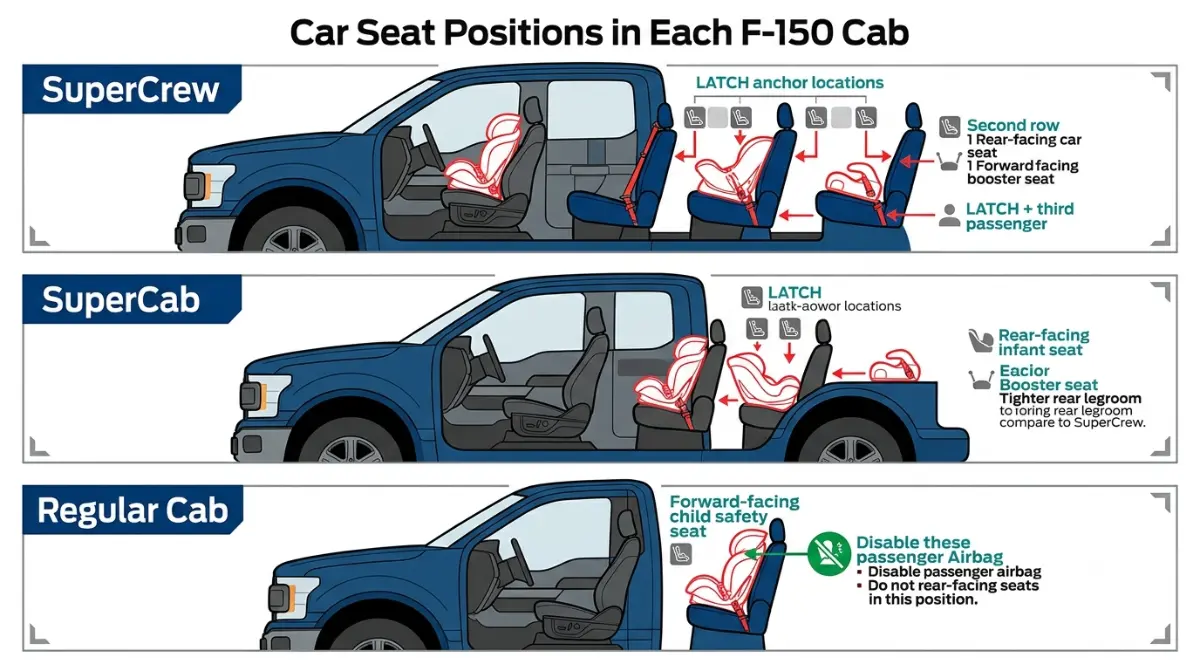
Table of Contents
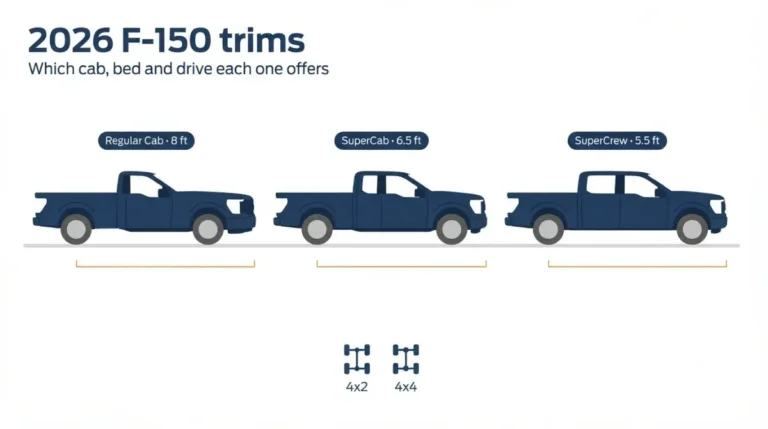
A 2021–2026 F-150 SuperCrew has two rear seats with complete LATCH hardware and a center seat with a tether anchor only. Ford’s 2021 owner’s guide puts lower anchors in the SuperCab’s rear seat and none in the Regular Cab, so the cab decides how many car seats can use lower anchors before seat width enters the picture.
Engines, axles and capacities by build sit on the F-150 specs by cab and configuration page.
Car seat positions in each F-150 cab
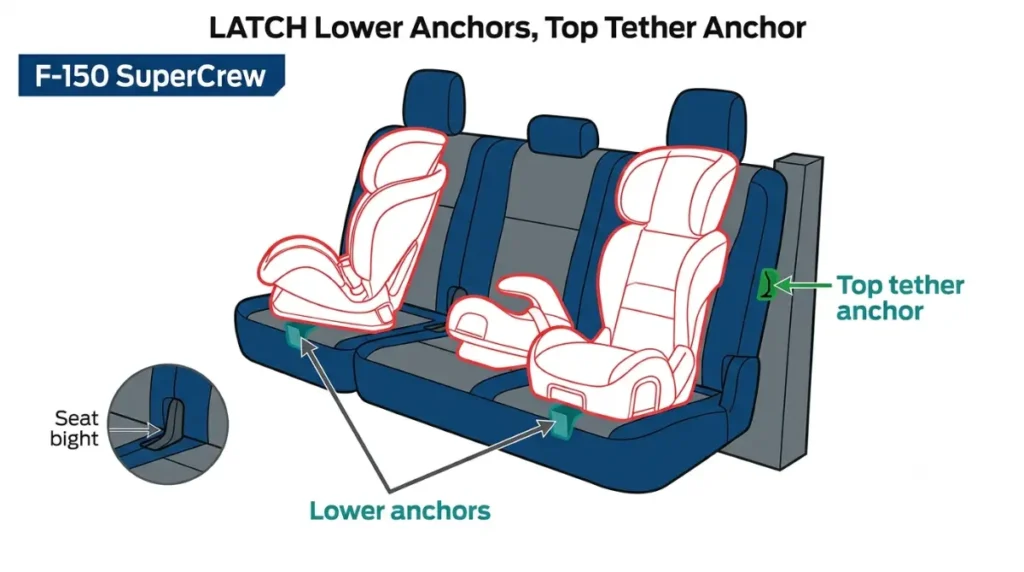
In the SuperCrew, three rear positions take a tether and two of them also take lower anchors. The other two cabs come from Ford’s own documents, because IIHS evaluated only the crew cab.
| Seat position | Lower anchors | Top tether | Applies to |
|---|---|---|---|
| SuperCrew rear left and right | Yes (seat bight) | Yes, on the back wall | 2021–2026 SuperCrew |
| SuperCrew rear center | None | Yes, on the back wall | 2021–2026 SuperCrew |
| SuperCab rear seat | Yes (seat bight); positions in the SuperCab diagram | In the SuperCab diagram | 2021 SuperCab |
| Regular Cab, all seats | None | In the Regular Cab diagram | 2021 Regular Cab |
Sources: SuperCrew rows from the IIHS child seat anchor evaluation for the 2021–2026 F-150 crew cab, based on an XLT SuperCrew with cloth seats. SuperCab and Regular Cab rows from the child restraint pages of Ford’s 2021 F-150 Supplemental Owner’s Guide.
The seat bight is Ford’s term for the crease where the rear cushion meets the backrest. IIHS found both outboard pairs visible in that crease, needing 0 lb of force to attach, with clearance angles between 66 and 73 degrees.
The F-150 Lightning has a separate owner’s manual and isn’t in this table. Battery and package differences for used Lightning trucks from 2022 to 2025 are broken down on their own page.
Check your own truck: The SuperCab and Regular Cab rows come from the 2021 edition. For any 2022–2026 truck, the lower anchor and top tether diagrams in that truck’s own manual settle which seats carry the hardware.
Hardware near the tether loops can pass for an anchor
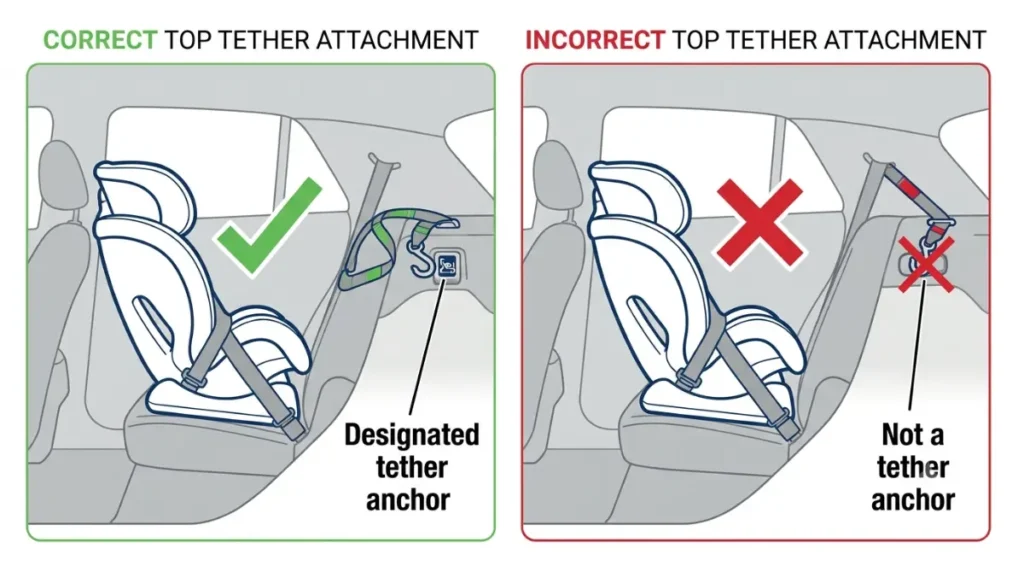
IIHS found other hardware on the SuperCrew’s back wall that could be confused for the tether anchors, and no contrasting label within 3 inches of any of the three. IIHS rates LATCH ease of use on 2021–2026 F-150 crew cabs Marginal, and those findings are recorded against all three positions.
Fits but shouldn’t: A tether hook clipped to the other hardware IIHS flagged near the loops is not on an anchor. Hook only to a loop shown in the manual’s top tether diagram, and trace the strap’s path against that diagram.
Use the tether every time a forward-facing seat goes in. NHTSA’s car seat guidance recommends it whether the seat is held by lower anchors or the seatbelt, as long as both the car seat maker and the vehicle maker allow it.
The supplemental guide describes three webbing loops above the rear seatback that serve as routing loops and as anchor loops. On seats with adjustable head restraints, the strap passes under the head restraint, between its posts.
A tether strap that won’t reach is a car seat question, and Ford sends owners to the seat’s maker for a longer strap.
Can three car seats fit across a SuperCrew?
Two LATCH sets and three seats means the middle seat installs with the seatbelt. IIHS lists the center position’s lower anchors as none available, and it doesn’t mark the center as a seat that can borrow from the outboard pairs. Hooking a center seat to the inner anchors of the side positions is off the table unless both the truck’s manual and the car seat’s manual allow it.
Weight decides the method too. The guide’s child restraint table sorts installs by the combined weight of child and car seat, with separate columns for lower anchors only and seatbelt only. Read that table alongside the car seat’s own instructions; once the combined weight passes the limit for lower anchors, the seat goes in with the seatbelt.
For a seatbelt install, pull the belt all the way out to put the retractor in automatic locking mode. Then push the car seat forward and back to make sure it’s held firmly.
Width is the last variable, and no table settles it. Three particular seats fit side by side or they don’t, depending on their bases and the bench, so bring them to the lot. Rear space also differs between the SuperCab and SuperCrew, and the F-150 lengths by cab and bed show how the cabs compare.
The Regular Cab has no lower anchors
Ford’s guide says so in one line, and the same pages show the Regular Cab’s top tether anchor points in a diagram. Every car seat in a Regular Cab therefore uses the seatbelt, in the front row.
That brings the airbag into it. In the airbag section of the 2021 guide, the rule is direct: a rear-facing car seat never goes in front of an active airbag. Read that section in the truck’s own manual before any front-row install, and have a certified technician check the passenger airbag status with the seat in place.
For 2026, the XL is the only series built as a Regular Cab; which 2026 F-150 series come in which cab covers the other seven.
The manual pages to read before you buy
On the lot, open the owner’s manual for that truck’s model year to the Child Safety chapter and find three pages:
- the lower anchor diagram for the cab you’re looking at
- the top tether anchor diagram, with the webbing loops marked
- the child restraint position table, sorted by combined weight
Then take your car seat for a check. NHTSA’s car seat page links to inspection stations and certified technicians. Ask the technician two things: whether the tether hook sits on a loop from the manual’s diagram, and whether the seat holds firm at the belt path or the anchors.
Found this helpful? See more of our guides on Google.
Want to see our guides first on Google?