F-150 generations by year and how to tell 2009–2027 apart

F-150 generation splits by year show up on trims: Ford returns the 5.0L V8 to King Ranch and Platinum for 2027, first time since 2023.
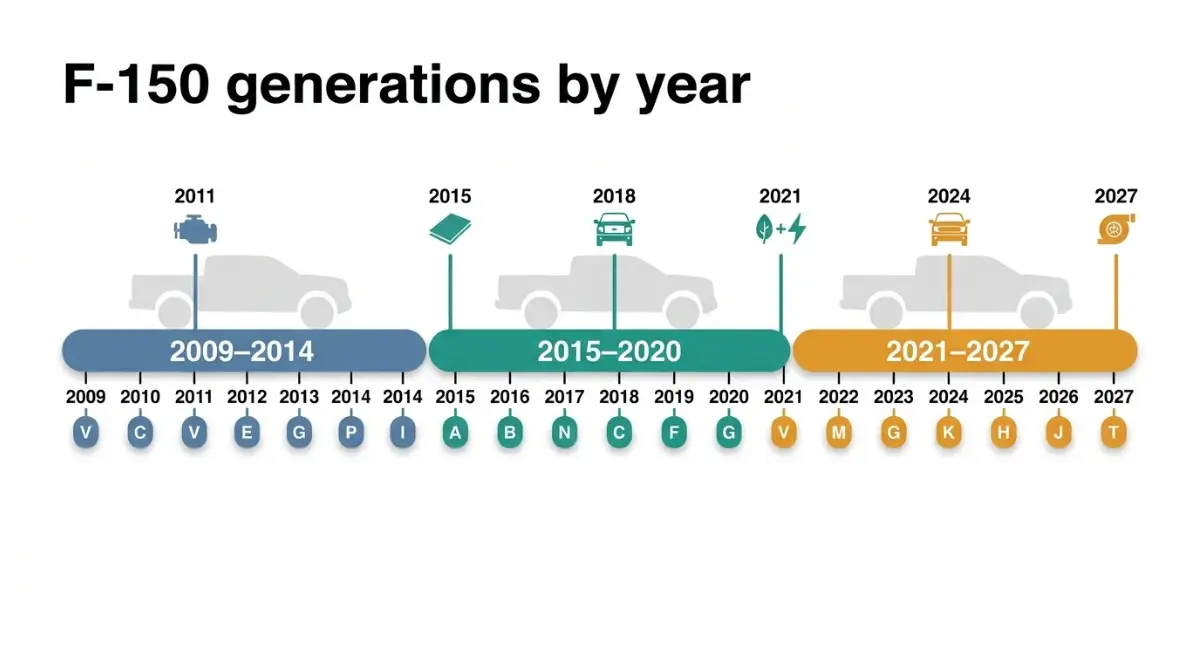
Table of Contents
Specs checked on November 5, 2026 against Ford’s F-150 specification sheets, brochures and press releases for the 2009 to 2027 model years, and the federal VIN year codes in 49 CFR 565.15.
The 12th-generation F-150 covers the 2009–2014 model years, the aluminum-bodied 13th covers 2015–2020, and the 14th began with the 2021 model year and runs through the 2027 update. The model year coded in position 10 of the VIN decides which generation a truck belongs to, so read it before trusting the styling or the year typed into a listing.
Each generation also splits partway through. Ford changed the engine lineup for 2011, 2018, 2024 and 2027, and a truck on one side of those lines can carry an engine the other side was never sold with.
Which generation is a 2009–2027 F-150?
| Model years | Generation, phase | VIN 10th character | Engines Ford listed | What changed |
|---|---|---|---|---|
| 2009–2010 | 12th, launch | 9, A | 4.6L 2-valve V8, 4.6L 3-valve V8, 5.4L 3-valve V8 | New truck; V8 engines only, no V6 |
| 2011–2014 | 12th, engine change | B, C, D, E | 3.7L V6, 5.0L V8, 6.2L V8, 3.5L EcoBoost V6 | Four new engines, each with a six-speed automatic |
| 2015–2017 | 13th, launch | F, G, H | 3.5L V6, 2.7L EcoBoost, 3.5L EcoBoost, 5.0L V8 | Aluminum-alloy body on a steel frame; 10-speed arrives with the second-generation 3.5L EcoBoost for 2017 |
| 2018–2020 | 13th, refresh | J, K, L | 3.3L V6, 2.7L EcoBoost, 3.5L EcoBoost, 5.0L V8, 3.0L Power Stroke diesel | New grilles, headlamps and bumpers; the 3.3L keeps a six-speed, the rest use the 10-speed |
| 2021–2023 | 14th, launch | M, N, P | 3.3L V6, 2.7L EcoBoost, 3.5L EcoBoost, 5.0L V8, 3.5L PowerBoost hybrid; diesel for 2021 only | PowerBoost hybrid and Pro Power Onboard generator added |
| 2024–2026 | 14th, refresh | R, S, T | 2.7L EcoBoost, 3.5L EcoBoost, 5.0L V8, 3.5L PowerBoost hybrid | 3.3L V6 dropped; 2.7L EcoBoost becomes the base engine |
| 2027 | 14th, update | V | 3.0L EcoBoost, 3.5L EcoBoost, 5.0L V8, 3.5L PowerBoost hybrid | 3.0L EcoBoost replaces the 2.7L; 5.0L V8 returns to King Ranch and Platinum |
Raptor engines and the electric Lightning are left out of the table.
Sources:
- Ford: 2009 F-150 brochure, 2011 powertrain release, 2015 aluminum-body retrospective, 2018 engine release, 2020 technical specifications, 2024 technical specifications, 2026 technical specifications and 2027 lineup announcement.
- 2021 hybrid: SAE’s report on the 2021 launch.
- Diesel’s final year: Ford’s confirmation to Equipment World.
Ford presents 2027 as an upgrade to the existing lineup. That means new grilles and wheels on XLT, Lariat, King Ranch and Platinum, the 3.0L EcoBoost as the base engine, BlueCruise with Towing and an F-150 Carhartt package.
The battery-electric F-150 Lightning was sold alongside these trucks. In its December 15, 2025 announcement, Ford said production of the current Lightning had concluded and that the next one will use an extended-range electric design. Model years and what to check on a used one are in buying a used F-150 Lightning, 2022–2025.
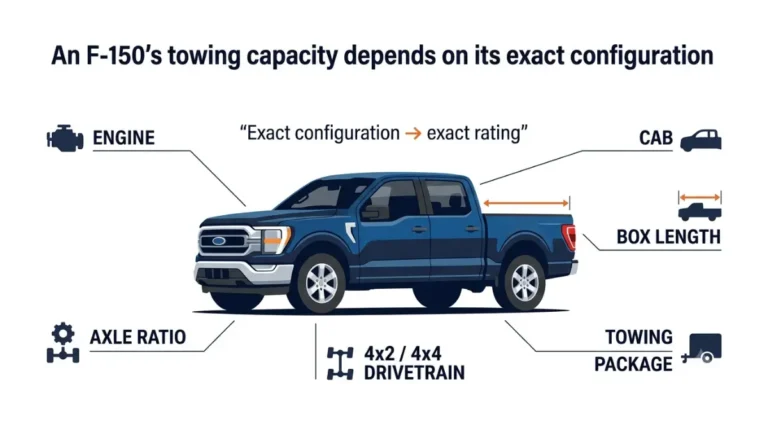
Cab, bed and engine figures for the 2021–2026 trucks, including payload and towing by build, sit in F-150 specs by configuration for 2021–2026.
Older F-150 generations, and why the counts differ
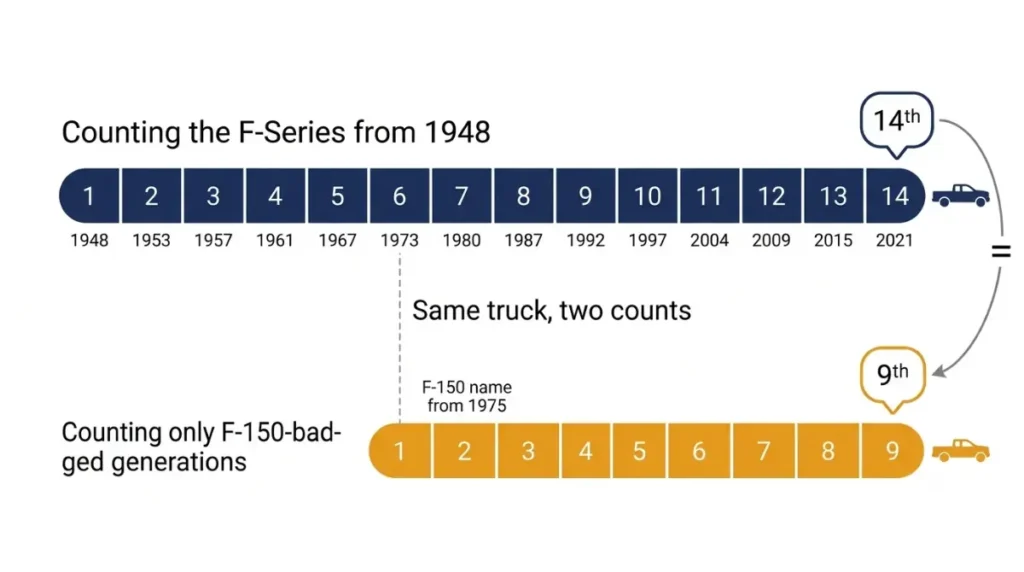
Published counts run anywhere from nine F-150 generations to fourteen, and the difference comes down to the starting line. Ford’s F-Series dates from the 1948 model year, and the F-150 name arrived for 1975, partway through the sixth generation.
Counting from 1948 makes the 2021 truck the 14th. Counting only the generations that wore an F-150 badge makes it the ninth.
| F-Series generation | First model year |
|---|---|
| 1st | 1948 |
| 2nd | 1953 |
| 3rd | 1957 |
| 4th | 1961 |
| 5th | 1967 |
| 6th | 1973 (F-150 name from 1975) |
| 7th | 1980 |
| 8th | 1987 |
| 9th | 1992 |
| 10th | 1997 |
| 11th | 2004 |
Published F-Series histories disagree by a year on where several generations end, mostly at changeovers, so the table gives first model years only. A few data sites draw their own lines wherever length or wheelbase changes, which produces yet another count.
The 10th VIN character settles the model year
A J in position 10 means a 2018, which puts the truck in the refreshed 13th generation with the 3.3L V6 as its base engine. The year codes come from the federal VIN rule and apply to every vehicle sold in the US.
| VIN 10th character | Model years | F-150 generation |
|---|---|---|
| 9 | 2009 | 12th |
| A, B, C, D, E | 2010–2014 | 12th |
| F, G, H, J, K, L | 2015–2020 | 13th |
| M, N, P, R, S, T | 2021–2026 | 14th |
| V | 2027 | 14th |
Source: 49 CFR 565.15, Table VII.
The code list skips I, O, Q, U and Z, which is why 2018 is J and 2027 is V. Letters also repeat on a 30-year cycle: A meant 1980 as well, under 49 CFR 565.25. Nobody confuses a 1980 F-150 with a 2010.
Check your own truck: The certification label on the driver’s door jamb carries the month and year the truck was built (49 CFR 567.4), and that date can fall in the calendar year before the model year. A truck finished late in 2017 can carry a 2018 VIN and 2018 engines, so match engines and parts to the VIN’s model year.
Listings that blur the 2018 and 2024 refresh years
A listing that calls a 2017 “the same as a 2018” is describing one aluminum body with two different front ends and two different base engines.
The 2018 front end, 3.3L V6 and diesel
The 2015–2017 base engine was a naturally aspirated 3.5L V6, and the 3.3L V6 replaced it for 2018. A 2016 advertised with a “3.3”, or a 2019 with a “3.5 V6”, has either the year or the engine wrong.
The diesel window is narrower still. Ford offered the 3.0L Power Stroke for the 2018 through 2021 model years, so an F-150 diesel dated outside 2018–2021 is not a configuration Ford built.
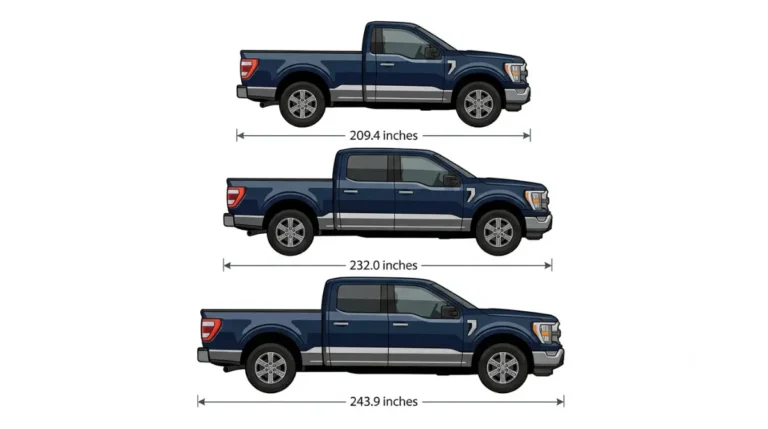
Box choices moved as well. The 2020 specification sheet shows the SuperCab with a 6.5-ft or 8.0-ft box; the 2024 sheet shows the SuperCab with the 6.5-ft box only. For each box length, the floor measurements match in both documents (67.1, 78.9 and 97.6 in). Which covers carry across these years is answered in tonneau cover fit across F-150 generations.
What the 2024 refresh removed
The 2024 specification sheet lists four engines for the regular lineup: the 2.7L EcoBoost, 5.0L V8, 3.5L EcoBoost and 3.5L PowerBoost hybrid. The 3.3L V6 is gone.
Trim access to the V8 narrowed too. Ford’s 2027 announcement says the 5.0L returns to King Ranch and Platinum for the first time since 2023. That makes a 2024–2026 King Ranch or Platinum listed with the 5.0L V8 a truck whose VIN you decode before going further.
| Engine | Model years Ford listed it |
|---|---|
| 4.6L and 5.4L V8s | 2009–2010 |
| 3.7L V6 and 6.2L V8 | 2011–2014 |
| 3.5L V6 (non-turbo) | 2015–2017 |
| 3.3L V6 | 2018–2023 |
| 3.0L Power Stroke diesel | 2018–2021 |
| 2.7L EcoBoost V6 | 2015–2026 |
| 3.5L EcoBoost V6 | 2011–2027 |
| 5.0L V8 | 2011–2027 |
| 3.5L PowerBoost hybrid | 2021–2027 |
| 3.0L EcoBoost V6 | 2027 |
Raptor engines excluded. Sources: the Ford documents listed under the generation table.
Which of these engines came on which 2021–2026 trims is in F-150 engine options by trim.
Check the original window sticker before paying
Three documents tell you what a used F-150 is.
- Position 10 of the VIN gives the model year, and with it the generation and phase.
- Ford’s Safety Compliance Certification Label, on the driver’s door jamb, gives the build month and the axle code (reading the F-150 axle ratio code).
- The original window sticker, if the seller kept it, lists the engine and packages the truck was built with.
If the door label is missing, Ford says replacements come only through a Ford dealer and only for vehicles up to five model years old. On an older truck, the VIN and the window sticker carry the whole check.
Found this helpful? See more of our guides on Google.
Want to see our guides first on Google?