F-150 Pro Power Onboard Outputs Documented by Engine and Package
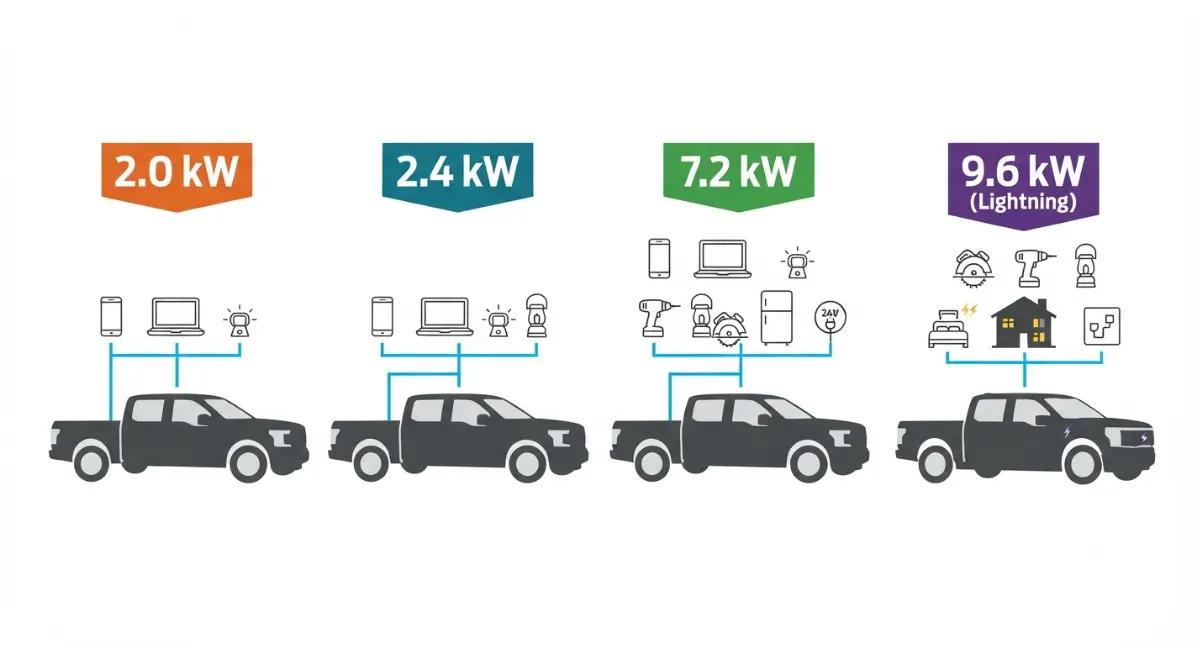
Table of Contents
Which Pro Power Onboard output does an F-150 get?
An F-150’s Pro Power Onboard output is set by its engine and package, not by the badge. At launch, Ford specified three tiers. 2.0 kW was available on optional gas engines, while PowerBoost-equipped trucks came standard with 2.4 kW or an optional 7.2 kW.
Three F-150 tiers, plus the Lightning
The electric F-150 Lightning uses a separate 9.6 kW system, which is not a gas or hybrid figure. It’s covered in its own section below.
Why “Pro Power Onboard” on a listing isn’t enough
Ford has expanded the name to cover 400 W outlets as well, now labelled “Pro Power Onboard — 400 W.” A listing that says “Pro Power” may mean a phone-charger-level outlet.
Start with the section that matches your situation:
- Pricing a new build: go to the engine matrix and the package section.
- Checking a used truck: go straight to the confirmation steps near the end.
- Sizing for a camper, tools or home backup: read the outlet and output sections first.
For towing, payload and fitment by build, see our F-150 specs by configuration.
ℹ️ Safety Note: Pro Power Onboard outputs are rated electrical limits, and loads above them should not be planned for. Connecting any generator source to home wiring without a transfer switch can send power back into utility lines. Use these figures for comparison, confirm your truck’s system, and leave any home connection to a licensed electrician.
📍 Check your own vehicle first: Specifications vary by build date, package and market, and two trucks with the same badge can be built differently. Before you buy anything based on this page, confirm against the window sticker or VIN build sheet, then on the truck itself. Ford says the easiest check is the center display: select Features, then Pro Power Onboard. If your vehicle disagrees with this page, your vehicle is right.
Pro Power Onboard output by engine, 2021–2026
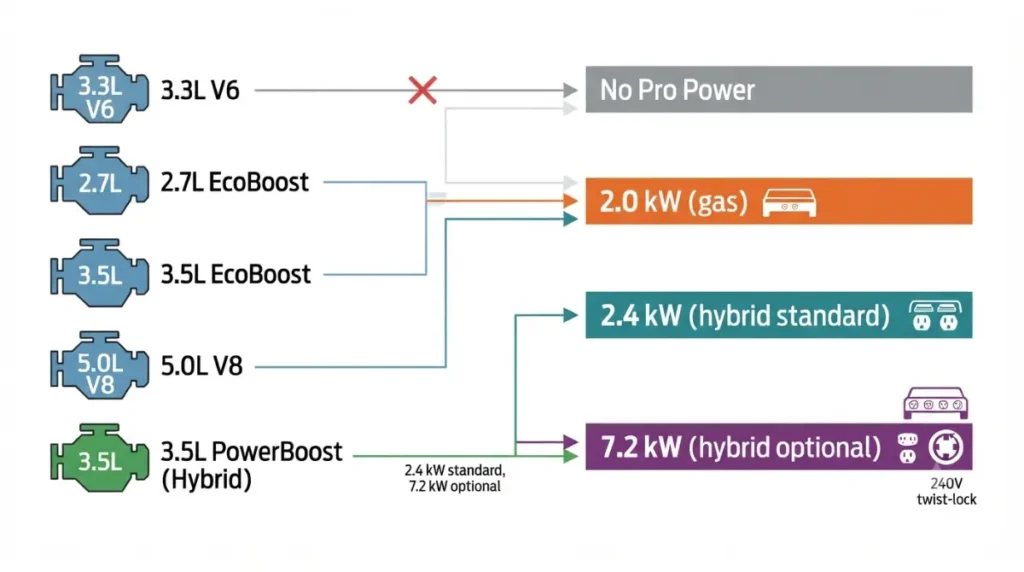
This table maps each gas and hybrid engine to the output Ford offered with it.
| Engine | Applies To | Pro Power Onboard output | What It Includes |
|---|---|---|---|
| 3.3L V6 | 2021–2023 | Not offered | Engine dropped for 2024 |
| 2.7L EcoBoost | 2021–2023 | 2.0 kW, optional | Bed outlets |
| 2.7L EcoBoost | 2024–2026 | — | |
| 3.5L EcoBoost | 2021–2026 | Bed outlets | |
| 5.0L V8 | 2021–2023 | 2.0 kW, optional | Bed outlets |
| 5.0L V8 | 2024–2026 | — | |
| 3.5L PowerBoost | 2021–2026 | 2.4 kW standard; 7.2 kW optional | 7.2 kW adds a 240V outlet |
Sources:
- 2021 tiers and the 3.3L exclusion: the 2.0 kW system went on any gas F-150 except the standard 3.3-liter V6, with 2.4 kW standard and 7.2 kW optional on the hybrid.
- 2024 changes: the 3.3-liter V6 was dropped for 2024, making the 2.7-liter EcoBoost the base engine, and the three tiers carried over for 2024.
2021–2023, when the 3.3L was excluded
In these years, a 3.3L truck cannot carry any Pro Power Onboard tier. Among 2.0 kW trucks, the engine choice doesn’t change the output.
2024–2026 after the refresh
The three output tiers held through the refresh. See which engines each F-150 trim offers before assuming a 2.0 kW-eligible engine is available on your trim.
2027 changes announced
- New base engine: a 3.0-liter EcoBoost V6 replaces the 2.7-liter, and PowerBoost lists available 2.4 kW and 7.2 kW Pro Power Onboard.
- 3.0L eligibility: Whether the 3.0L can take 2.0 kW is.
- Raptor: Ford’s 2027 F-150 specs and features announcement covers the full lineup. The new entry-level Raptor deletes Pro Power Onboard.
What outlets each output level gives you
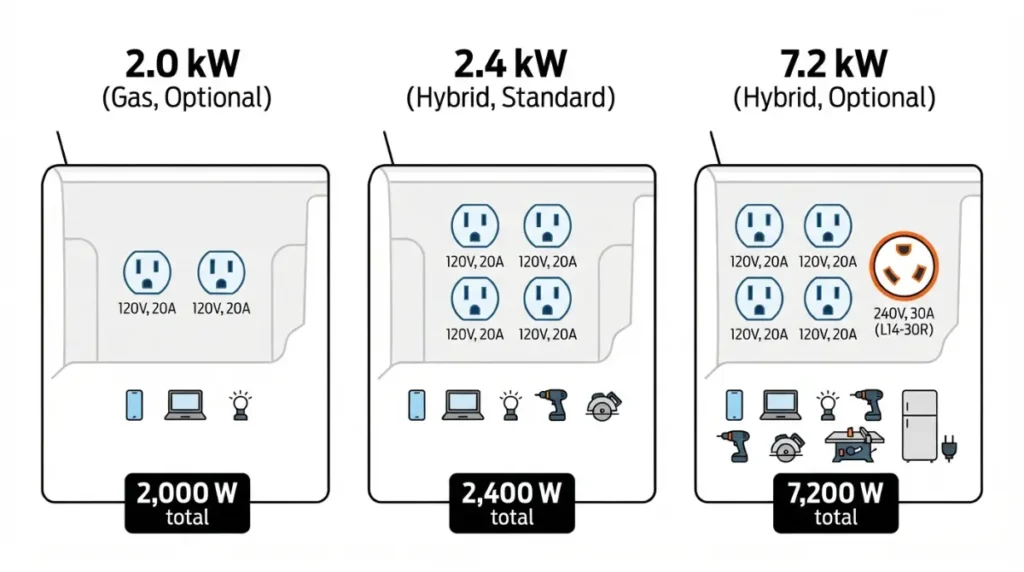
The outlet layout differs by tier, and that matters as much as the kilowatt number.
2.0 and 2.4 kW bed outlets
The base systems use a bed cluster with two 120-volt 20-amp outlets. Cab-outlet ratings by tier are.
7.2 kW adds a 240V twist-lock
The 7.2 kW system has four 120V outlets rated at 20A each, plus one 240V NEMA L14-30R outlet.
Which trims and packages include Pro Power Onboard
On the hybrid, package codes decide whether you get 2.4 kW or 7.2 kW.
2026 package codes for the 7.2 kW
📐 On the Spec Sheet: For 2026, 7.2 kW is optional with the PowerBoost on King Ranch and Platinum 700A, and included on Platinum 701A, 702A and 703A. PowerBoost also became available on STX 200A. Source: Ford’s What’s New for the 2026 F-150.
Compare equipment groups in our 2026 F-150 trims breakdown.
The 400 W and storage-box alternative
From 2024, trucks without Pro Power Onboard could instead get a single 400W bed outlet, or no outlet and a second storage box.
The 2027 entry-level Raptor deletion
A 2027 Raptor build may have no Pro Power Onboard at all, so confirm the equipment group on the window sticker.
What 2.0, 2.4 and 7.2 kW actually cover
Each kilowatt figure is the whole system’s output limit. It is not a per-outlet allowance.
A system limit, not a per-outlet figure
🔍 What This Spec Means: A 120V outlet rated at 20A works out to 2,400 W. On the 2.0 kW system, a single outlet’s rating already exceeds the system’s total. The same arithmetic makes the 240V 30A outlet 7,200 W, which equals the entire 7.2 kW budget.
Runtime claims and the fuel tank
- Runtime: Ford quotes up to 85 hours on a full tank at 2.4 kW, and 32 hours for its 7.2 kW metal-shop scenario. Both figures assume a full tank, so tank size changes the real number. Our PowerBoost vs 3.5 EcoBoost comparison sets out the trade-offs.
- How each system draws power: The hybrid systems draw from the battery before starting the engine, while the 2.0 kW system runs the engine to power the outlets.
✅ Do This: Before relying on the truck for a specific load, list each device’s running and starting wattage. Ask a licensed electrician whether the total stays under your truck’s rated output, and which outlet each device should use.
Home backup, 240V use, and the Lightning’s 9.6 kW
Home backup is the use where buying the wrong tier costs the most.
Transfer switch required
Ford supports essential home backup on a PowerBoost or Lightning truck equipped with the available system plus a GenerLink transfer switch, sold separately. Among gas and hybrid F-150s, only the 7.2 kW system has the 240V outlet.
✅ Do This: Ask a licensed electrician three things. Does the transfer switch accept an L14-30 connection? Is it rated for 30 amps at 240 volts? Which home circuits fit within 7.2 kW?
Why 9.6 kW isn’t an F-150 gas or hybrid figure
The Lightning’s 9.6 kW system splits into 2.4 kW for the cabin and frunk and 7.2 kW in the bed.
How to confirm which system a used F-150 has
Three checks on the truck settle what a listing can’t.
Button location and the 240V outlet tell you the tier
- Center display: Open Features, then Pro Power Onboard. The 400 W system won’t appear on the center display or in the Ford app.
- Dash button: The 2.0 kW system has a hard button on the dash, while the 2.4 and 7.2 kW buttons sit above the center display.
- Bed outlets: A 240V twist-lock in the bed means 7.2 kW.
Why dealer pages and listings mislead
Beyond the 400 W naming, dealer copy contradicts Ford. One dealer page lists 2.0 kW as standard on PowerBoost models, against Ford’s 2.4 kW. Ford’s Pro Power Onboard support guide is the reference to check against.
F150 Pro Power Onboard FAQ
1. Which F-150 has 7.2 kW Pro Power Onboard?
Only the 3.5L PowerBoost hybrid offers 7.2 kW Pro Power Onboard. For 2026 it’s optional on King Ranch and Platinum 700A, and included on Platinum 701A–703A.
2. Is Pro Power Onboard standard on the F-150 hybrid?
Yes. Every PowerBoost F-150 from 2021–2026 includes 2.4 kW Pro Power Onboard as standard, with 7.2 kW available as an option.
3. Can a gas F-150 get Pro Power Onboard?
Yes. From 2021–2023, 2.0 kW Pro Power Onboard was optional on the 2.7L, 3.5L EcoBoost and 5.0L, but never on the 3.3L V6.
4. What plug is the F-150 Pro Power Onboard 240V utlet?
The 7.2 kW system’s 240V outlet is a 30-amp NEMA L14-30R twist-lock. Common RV plugs such as the TT-30 and 14-50 don’t fit it directly.
5. How long does F-150 Pro Power Onboard run on a tank?
Ford quotes up to 85 hours at 2.4 kW and 32 hours at 7.2 kW. Both figures start from a full tank.
6. Can F-150 Pro Power Onboard power a house?
Ford supports essential home backup with a 240V-equipped system and a GenerLink transfer switch. Have a licensed electrician confirm the installation first.
7. Is F-150 Pro Power Onboard 2.0 kW enough for tools?
The 2.0 kW system’s total output is lower than one 20-amp outlet’s 2,400-watt rating. Add up your tools’ wattage before relying on it.
8. How can I tell which Pro Power Onboard a used F-150 has?
Open Features, then Pro Power Onboard, on the center display. Check where the button sits, and look for a 240V twist-lock in the bed.
9. Does “Pro Power Onboard” on a listing mean a generator?
Not necessarily. Ford also calls 400 W outlets Pro Power Onboard, so confirm the kilowatt rating on the window sticker.
10. Does the Lightning’s 9.6 kW Pro Power Onboard apply to gas F-150s?
No. The Lightning’s 9.6 kW Pro Power Onboard is 2.4 kW plus 7.2 kW circuits. Gas and hybrid F-150s top out at 7.2 kW.
Before you buy: three rules
Engine sets the tier, the package decides 2.4 kW versus 7.2 kW, and a listing’s wording proves nothing. Confirm the kilowatt figure on the window sticker or VIN build sheet, then on the center display, before you pay for a specific truck. If you plan to connect a home, a licensed electrician comes before the purchase.