F-150 specs by configuration for each engine and axle

F-150 configuration ratings for 2026, axle by axle, plus Ford’s 2027 swap of the 2.7L for a 3.0L EcoBoost tow-rated 8,400 lb (4×2) and 8,200 lb (4×4).
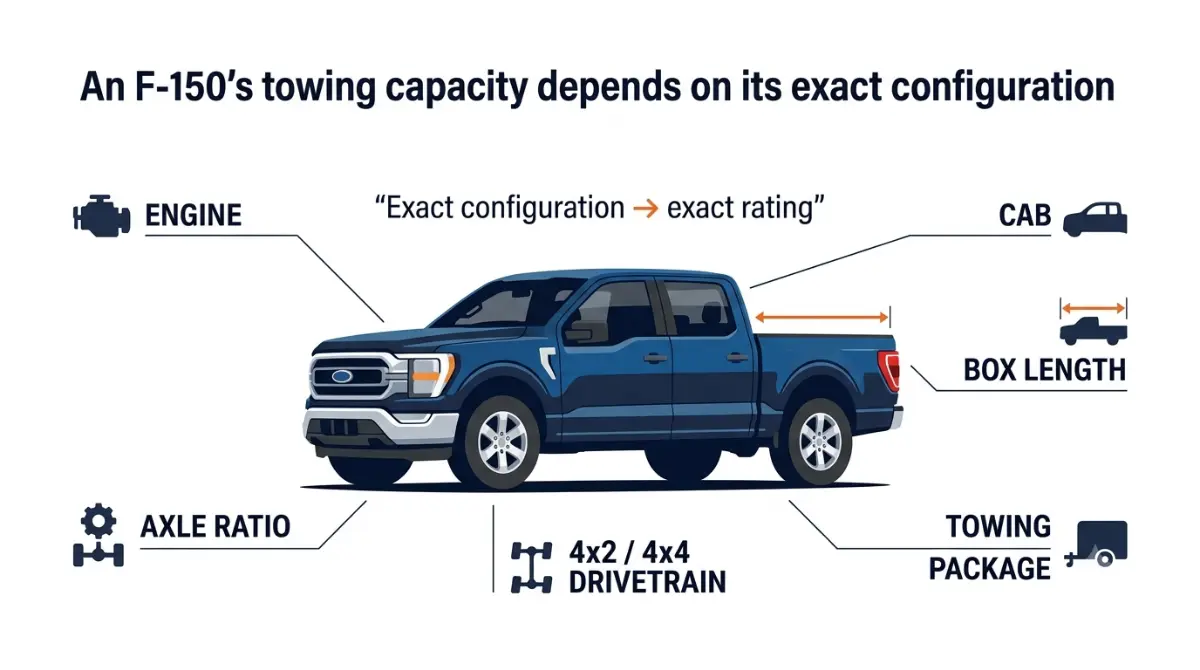
Table of Contents
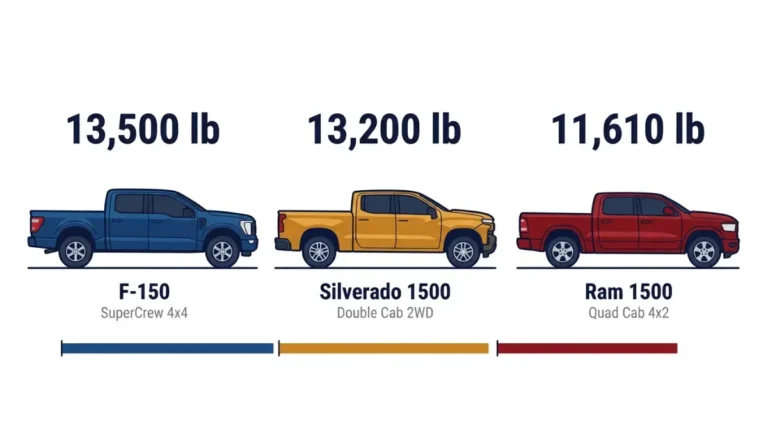
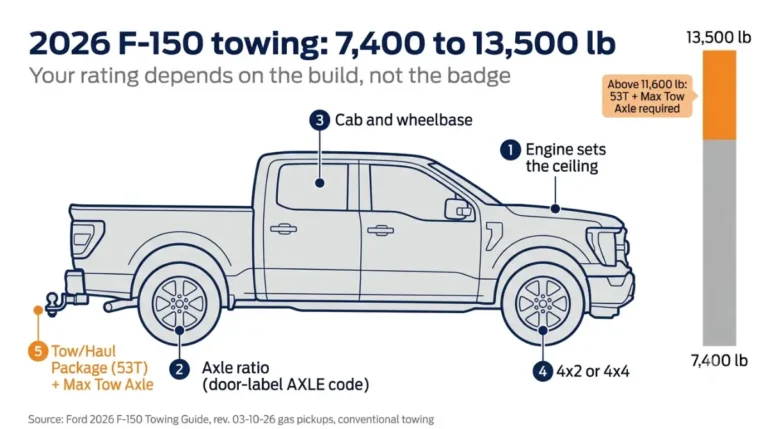
For 2026, Ford rates the F-150 to tow from 7,400 lb (2.7L EcoBoost on a 3.15 or 3.55 axle) to 13,500 lb (3.5L EcoBoost SuperCrew 4×4 with the Tow/Haul Package, code 53T, and the optional Max Tow Axle). The engine sets the ceiling, and the axle ratio plus that package pairing decide how close a given truck gets to it.
Each figure below belongs to one engine, axle, cab and drivetrain. Payload and trailer frontal area add limits of their own, and the lowest limit that applies to your trailer is the one that counts.
Five variables behind each F-150 rating
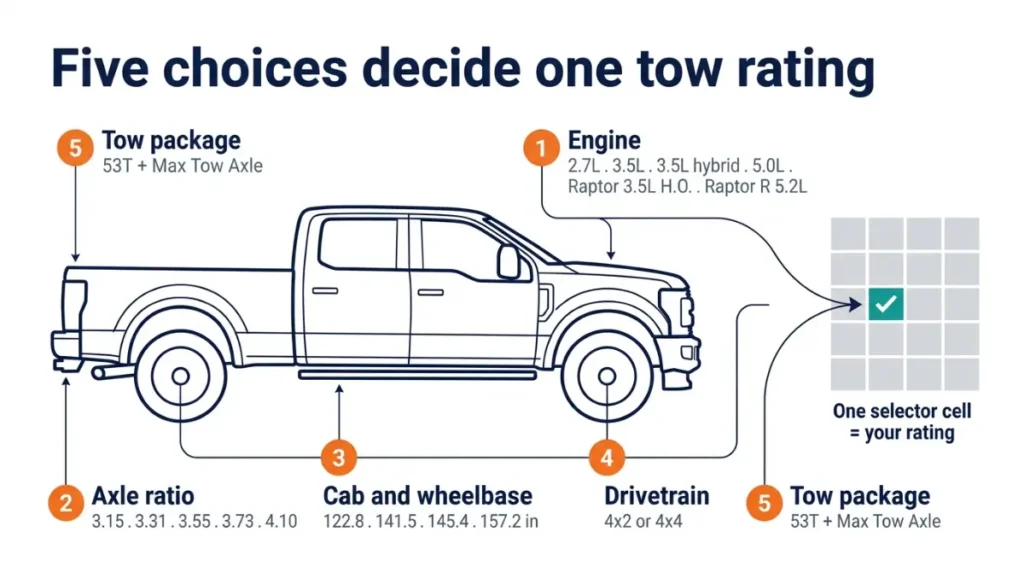
Ford’s 2026 selector prints up to nine cab-and-wheelbase columns for each engine and axle, so one engine carries several trailer ratings on a single page. Five choices decide which cell belongs to a given truck.
| Variable | 2026 options | What it changes | Where it shows on the truck |
|---|---|---|---|
| Engine | 2.7L EcoBoost, 3.5L EcoBoost, 3.5L PowerBoost hybrid, 5.0L V8, 3.5L EcoBoost H.O. (Raptor), 5.2L supercharged V8 (Raptor R) | Ceiling for towing and payload | Window sticker |
| Axle ratio | 3.15, 3.31, 3.55, 3.73, 4.10 | GCWR, and the trailer rating under it | AXLE code on the Safety Compliance Certification Label |
| Cab and wheelbase | Regular Cab (122.8 or 141.5 in), SuperCab (145.4 in), SuperCrew (145.4 or 157.2 in) | Which selector column applies | Window sticker |
| Drivetrain | 4×2 or 4×4 | Payload and some trailer ratings | Window sticker |
| Tow package | Tow/Haul Package (53T) with the optional Max Tow Axle | Opens the highest GCWR rows | Window sticker or build sheet |
Sources: Ford 2026 F-150 Towing Guide, trailer towing selector; Ford 2026 F-150 Technical Specifications, steering and dimension tables.
GCWR, the gross combined weight rating, is the most the loaded truck and loaded trailer may weigh together. Ford calculates it with the SAE J2807 method. The trailer rating printed beside each GCWR assumes the truck carries its required equipment plus a 150-lb driver and passenger. Anything added beyond that, whether cargo or options, comes off what the trailer may weigh.
2026 F-150 towing range by engine and axle
The same 3.5L EcoBoost spans 10,500 to 13,500 lb in Ford’s 2026 selector, depending on axle ratio and package. That spread is why a single headline figure tells a buyer so little.
| Engine | Axle ratio | GCWR (lb) | Conventional trailer (lb) | Applies to / requires |
|---|---|---|---|---|
| 2.7L EcoBoost | 3.15, 3.55 | 12,300–13,000 | 7,400–7,600 | Regular Cab 141.5-in WB, SuperCab, SuperCrew |
| 2.7L EcoBoost | 3.73 | 13,300–13,500 | 8,000–8,400 | Same cabs |
| 5.0L V8 | 3.15, 3.31 | 14,800–14,900 | 9,100–9,600 | All cabs |
| 5.0L V8 | 3.73 | 13,900–15,900 | 9,000–10,500 | All cabs; Tremor rated 10,000 |
| 5.0L V8 | Max Tow Axle | 17,700–18,400 | 12,300–12,800 | Requires 53T and the Max Tow Axle |
| 3.5L EcoBoost | 3.31, 3.55 | 16,200–17,700 | 10,500–11,000 | Cabs offered with this engine |
| 3.5L EcoBoost | 3.73 | 17,100 | 10,600 | Tremor |
| 3.5L EcoBoost | Max Tow Axle | 19,300–19,400 | 13,100–13,500 | SuperCrew; requires 53T |
| 3.5L PowerBoost hybrid | 3.55, 3.73 | 17,100 | 10,800–11,100 | SuperCrew only |
| 3.5L PowerBoost hybrid | Max Tow Axle | 18,400 | 11,500–12,400 | SuperCrew only; requires 53T |
| 3.5L EcoBoost H.O. | 4.10 | 14,600–14,650 | 8,200 | Raptor |
| 5.2L supercharged V8 | 4.10 | 15,300 | 8,700 | Raptor R |
| Electric | 9.61 | 15,000–17,300 | 7,700–10,000 | Lightning SuperCrew 4×4; 53D required above 5,000 lb |
Source: Ford 2026 F-150 Towing Guide, conventional towing selector for the F-150 pickup, F-150 Hybrid and F-150 Lightning.
Each range covers the cab and wheelbase columns in its row. To narrow a truck to one cell, read the engine and package off the window sticker and the axle code off the door label. Then ask the dealer to print the selector row for that VIN, with its GCWR. The grid cell by cell is laid out in the F-150 towing chart by cab and wheelbase.
The 3.5L 4×4 out-rates the 4×2
Ford’s 2026 technical specifications put the 3.5L EcoBoost at 13,300 lb as a 4×2 and 13,500 lb as a 4×4, both SuperCrew with 53T and the Max Tow Axle. Neither the spec sheet nor the towing guide gives a reason. The 2023 guide ran the other way, reserving its 14,000-lb peak for 4×2 trucks.
Hybrid ratings by drivetrain
The towing guide’s summary table lists the PowerBoost hybrid at 11,600 lb, which matches the 4×4 figure in the spec sheet. A 4×2 hybrid with the same package pairing is rated 12,400 lb. Every hybrid is a SuperCrew on a 145.4- or 157.2-inch wheelbase, and the hybrid’s ratings by axle and wheelbase break those rows down further.
53T and the Max Tow Axle: where the top ratings live
Two 3.5L SuperCrews can sit 2,500 lb apart on paper: 11,000 lb at the top of the standard rows, and 13,500 lb once the truck carries the Tow/Haul Package and the optional Max Tow Axle. Ford’s required-equipment rules decide where that step falls.
| Requirement or limit | 2026 figure | Applies to |
|---|---|---|
| Tow/Haul Package (53T) and Max Tow Axle required | Trailers over 11,600 lb | F-150 gas pickup |
| Same package pairing required | Trailers over 10,800 lb | F-150 Hybrid |
| Max Trailer Tow Package (53D) required | Trailers over 5,000 lb | F-150 Lightning |
| Weight-distribution system required | Trailers over 5,000 lb | All F-150 models in the guide |
| Standard 2-in hitch receiver | 11,600 lb | F-150 pickup |
| Reinforced 2-in hitch receiver | 14,000 lb | Included with the Max Tow Axle |
| Weight-carrying maximum | 5,000-lb trailer, 500-lb tongue | F-150 pickup |
| Weight-distributing maximum | 13,500-lb trailer, 1,400-lb tongue | F-150 pickup with the package pairing |
Source: Ford 2026 F-150 Towing Guide, required equipment, factory-installed hitch receiver and hitch receiver weight capacity tables.
The same table warns that the New Vehicle Limited Warranty may be voided if you tow without the listed equipment. Weight distribution is a separate line, and above 5,000 lb it applies to every F-150 whatever the engine.
Before you hitch: The 14,000-lb figure on a reinforced receiver is the hitch’s own capacity. Ford states that receiver capacities may exceed the maximum loaded trailer weight for the vehicle, so the trailer limit comes from the truck’s selector row. Have the hitch installer read the receiver label with you and confirm the tongue load stays within the 1,400-lb weight-distributing maximum.
What sits inside each package is covered in how the Tow/Haul Package and Max Tow Axle differ. Receiver figures for earlier years are in F-150 hitch receiver ratings by model year.
How much payload is left once the trailer is hitched?
Pair a 13,500-lb travel trailer with a 3.5L SuperCrew 4×4, and the tongue alone puts 1,350 lb on the truck at Ford’s guideline of 10% of loaded trailer weight. Ford’s 2026 spec sheet gives 2,175 lb as the maximum payload for a 3.5L 4×4. Subtract the tongue and 825 lb is left for passengers, gear and the hitch, worked out from those two published figures.
That 2,175 lb is the best case. The spec sheet’s footnote says payload varies with accessories and configuration, and it sends you to the doorjamb label for a specific truck’s carrying capacity.
| Engine | 2026 max payload, 4×2 / 4×4 (lb) | 2027 max payload, 4×2 / 4×4 (lb) | Applies to |
|---|---|---|---|
| 2.7L EcoBoost (2026), 3.0L EcoBoost (2027) | 1,775 / 1,715 | 1,755 / 1,700 | Base engine in each year |
| 5.0L V8 | 2,235 / 2,080 | 2,235 / 2,080 | All cabs offered |
| 3.5L EcoBoost | 2,440 / 2,175 | 2,440 / 2,175 | All cabs offered |
| 3.5L PowerBoost hybrid | 2,045 / 1,740 | 2,045 / 1,740 | SuperCrew only |
| 3.5L EcoBoost H.O. | Not offered / 1,405 | Not offered / 1,405 | Raptor |
| 5.2L supercharged V8 | Not offered / 1,410 | Not offered / 1,410 | Raptor R, 37-in tire application |
Sources: Ford 2026 F-150 Technical Specifications and Ford 2027 F-150 Technical Specifications, engine tables.
A fifth-wheel or gooseneck trailer moves 15% of its loaded weight onto the truck, against 10% for a conventional trailer. Either way, that load plus passengers and cargo cannot push the truck past its GVWR or its rear GAWR. Both are printed on the Safety Compliance Certification Label at the driver’s door jamb. A pass across a truck scale with the trailer hitched and everyone aboard shows where the truck sits against both.
Payload by trim and cab is broken out in the F-150 payload capacity chart, and how tongue weight eats into F-150 payload works through more trailer sizes.
On a 2.7L, the axle ratio also sets trailer size
AXLE 19 on a 2026 2.7L’s door label means a 3.55 open differential, and Ford’s selector rates that pairing at 7,400 to 7,600 lb. Ford also ties a trailer frontal-area limit to the rating. Frontal area is the total area the truck and trailer present to the air, and the limit steps up with the tow rating.
| Truck’s trailer rating | Max trailer frontal area | 2026 builds in this band |
|---|---|---|
| 7,700 lb or less | 55 sq ft | 2.7L on a 3.15 or 3.55 axle (7,400–7,600 lb) |
| 7,701 lb and up | 65 sq ft | 2.7L on a 3.73 axle; 5.0L, 3.5L EcoBoost, hybrid, Raptor, Raptor R |
| Fifth-wheel or gooseneck | 75 sq ft | F-150 pickups rated for fifth-wheel towing |
| Lightning | 60 sq ft | F-150 Lightning |
Source: Ford 2026 F-150 Towing Guide, frontal area limitation and basic towing information.
Ford says exceeding these limits may significantly reduce the towing vehicle’s performance. Its basic towing notes advise a higher-rated vehicle for trailers with a large frontal area, or for hilly and mountainous terrain.
Fits but shouldn’t: A tall travel trailer can weigh less than a 2.7L 3.55 truck’s 7,400-lb rating and still be larger than its 55 sq ft frontal-area limit. The same engine on the 3.73 axle is rated 8,000 to 8,400 lb, which moves it into the 65 sq ft band. Compare the trailer maker’s published height and width with the band before choosing the axle.
Fifth-wheel limits on the hybrid and 5.5-ft box
The 2026 selector rates the PowerBoost hybrid at 7,100 to 9,200 lb for fifth-wheel and gooseneck trailers, well under its 10,800- to 12,400-lb conventional rows. Ford footnotes the 5.5-ft box separately: it “will accept a 5th-wheel hitch but most 5th-wheel trailer designs are not compatible with this model.” Fifth-wheel towing is not recommended at all on the Raptor or the Lightning. The guide’s clearance table gives a maximum closed-tailgate height of 58.3 in for a 4×4 at base curb weight, measured from the ground to the top of the tailgate lip.
3.0L EcoBoost replaces the 2.7L for 2027
Ford’s 2027 F-150 technical specifications, version 1.0 dated September 15, 2026, list a 3.0L EcoBoost V6 as the smallest engine and no longer list the 2.7L.
| Engine | hp @ rpm | lb-ft @ rpm | Max tow, 4×2 / 4×4 (lb) | Applies to |
|---|---|---|---|---|
| 3.0L EcoBoost V6 | 325 @ 5,500 | 400 @ 2,250 | 8,400 / 8,200 | New base engine for 2027 |
| 5.0L V8 | 400 @ 6,250 | 410 @ 4,250 | 12,800 / 12,800 | Tow figures: SuperCrew with 53T and Max Tow Axle |
| 3.5L EcoBoost V6 | 400 @ 5,250 | 500 @ 3,500 | 13,300 / 13,500 | Tow figures: same requirement |
| 3.5L PowerBoost hybrid | 430 @ 5,250 | 570 @ 3,500 | 12,400 / 11,600 | Tow figures: same requirement; combined engine and motor output |
| 3.5L EcoBoost H.O. | 450 @ 5,250 | 510 @ 3,500 | Not listed / 8,200 | Raptor; premium-fuel ratings |
| 5.2L supercharged V8 | 720 @ 6,650 | 640 @ 4,300 | Not listed / 8,700 | Raptor R; premium-fuel ratings |
Source: Ford 2027 F-150 Technical Specifications, engine table. Ford’s footnote names the package “Max Tow/Haul Package (53T).”
On paper, the 3.0L matches the 2.7L it replaces on horsepower, torque and both tow ratings. Its peak torque arrives at 2,250 rpm, against 3,500 rpm for the 2026 2.7L. Its maximum payload is 20 lb lower as a 4×2 and 15 lb lower as a 4×4. The other five engines carry the same output, tow and payload figures in the 2026 and 2027 spec sheets.
The 2027 sheet prints no GCWR and no selector rows. Those arrive with a 2027 towing guide, so the axle-by-axle ranges higher up this page describe 2026 trucks and don’t carry over to a 2027 build.
The 2027 sheet also lists no electric powertrain. For 2026 Lightning trucks, the towing guide’s required-equipment table calls for the Max Trailer Tow Package (53D) on any trailer over 5,000 lb. Two selector rows, at 7,700 and 8,700 lb, carry no 53D footnote, which conflicts with that table. Confirm 53D on a Lightning’s window sticker before relying on any rating above 5,000 lb.
Which rules apply to a used 2021–2023 truck?
A used listing that claims 14,000 lb of towing is describing a narrow build. In Ford’s 2023 guide, that figure applied only to a SuperCab 8-ft box 4×2 or a SuperCrew 4×2 with the 3.5L EcoBoost and the Max Trailer Tow Package (53C).
| Item | 2023 model year | 2026 model year | Code on the build sheet |
|---|---|---|---|
| Package behind the top ratings | Max Trailer Tow Package | Tow/Haul Package plus Max Tow Axle | 53C (2023); 53T (2026) |
| 3.5L EcoBoost maximum | 14,000 lb, 4×2 only | 13,500 lb, SuperCrew 4×4 | Engine plus package |
| 2.7L EcoBoost maximum | 10,100 lb with the 2.7L Payload Package | 8,400 lb | 622 (2023) |
| 5.0L V8 maximum | 13,000 lb | 12,800 lb | 53C (2023); 53T (2026) |
| Hybrid maximum | 12,700 lb | 12,400 lb (4×2), 11,600 lb (4×4) | 53C (2023); 53T (2026) |
| 3.3L V6 | 8,200 lb | Not offered | None |
| Maximum payload | 3,315 lb (Regular Cab 8-ft box 4×2, 5.0L, with 53C and the Heavy-Duty Payload Package) | 2,440 lb (3.5L 4×2) | 627 (2023) |
| Frontal-area limit above a 7,700-lb rating | 60 sq ft | 65 sq ft | None |
Sources: Ford 2023 RV & Trailer Towing Guide, F-150 summary, frontal area and selector pages; Ford 2026 F-150 Towing Guide and 2026 technical specifications.
A hitch on a 2023 truck settles little by itself. Ford’s 2023 selector caps a truck that has only the Class IV hitch (53B), and no Trailer Tow Package (53A), at 6,000 lb with the 3.3L or 2.7L. The same hitch-only cap is 7,000 lb with the 5.0L. It is also 7,000 lb for the 3.5L EcoBoost and the hybrid.
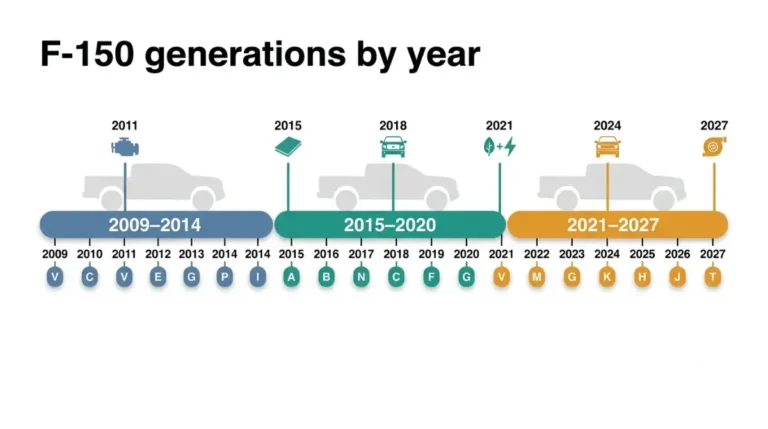
Ford issues a towing guide for each model year, and 2021 and 2022 trucks are rated in their own editions. Where this generation starts and which years share it is set out in F-150 generations by year.
Cab, box and wheelbase in one table
157.2 inches is the SuperCrew 6.5-ft box’s wheelbase, and it is the column to read in Ford’s selector for that truck.
| Cab and box | Wheelbase (in) | Length (in) | Box floor length / volume | Applies to |
|---|---|---|---|---|
| Regular Cab, 6.5-ft box | 122.8 | 209.4 | 78.9 in / 62.3 cu ft | 2026 and 2027, 4×2 and 4×4 |
| Regular Cab, 8-ft box | 141.5 | 228.1 | 97.6 in / 77.4 cu ft | 2026 and 2027, 4×2 and 4×4 |
| SuperCab, 6.5-ft box | 145.4 | 232.0 | 78.9 in / 62.3 cu ft | 2026 and 2027, 4×2 and 4×4 |
| SuperCrew, 5.5-ft box | 145.4 | 232.0 | 67.1 in / 52.8 cu ft | Tremor: 145.6 WB, 231.5 length; Raptor: 67.2-in floor, 232.3 length |
| SuperCrew, 6.5-ft box | 157.2 | 243.8 (4×2), 243.9 (4×4) | 78.9 in / 62.3 cu ft | 2026 and 2027 |
Source: Ford 2026 F-150 Technical Specifications, exterior dimensions and cargo capacities; the 2027 sheet lists the same figures.
The SuperCab 6.5-ft and the SuperCrew 5.5-ft share the 145.4-in wheelbase and the 232.0-in length. Check the cab name as well as the wheelbase when reading a selector column.
All three boxes measure 50.6 in between the wheelhouses and 21.4 in tall at the molding. Width on non-Raptor trucks runs 79.7 to 79.9 in without mirrors and 105.9 in with trailer tow mirrors, which Ford doesn’t list for the Tremor or Raptor. Length for every cab and bed pairing is broken down in F-150 length by cab and bed.
Tire sizes by trim and drivetrain
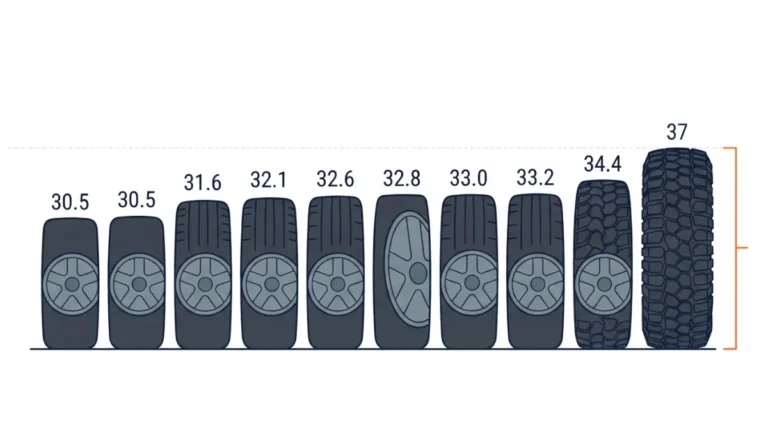
265/70R17C is an option on the 2026 F-150 XL Fleet and with the FX4 Package. The C at the end is a load-range marking that the standard 265/70R17 on a 4×4 XL does not carry.
| Size | Standard or optional | Applies to |
|---|---|---|
| 245/70R17 all-season | Standard | XL, XLT 4×2 |
| 265/70R17 all-terrain | Standard | XL 4×4 |
| 265/60R18 all-season | Standard | STX, Lariat 4×2; optional on XLT 4×2 |
| 275/65R18 all-terrain | Standard | STX, XLT, Lariat 4×4 |
| 275/70R18 all-terrain | Standard | Tremor |
| 275/60R20 | Standard | King Ranch, Platinum (all-season 4×2, all-terrain 4×4) |
| LT315/70R17 all-terrain | Standard | Raptor |
| 265/70R17C all-terrain | Optional | XL Fleet, FX4 Package |
| 265/70R18C all-terrain | Optional | XLT 4×4 |
| 275/50R22 all-season | Optional | STX Lobo Package, King Ranch, Platinum |
| 37×12.5R17 all-terrain | Optional | Raptor 37 Package |
Source: Ford 2026 F-150 Technical Specifications, tires; the 2027 sheet lists the same sizes.
A same-size tire without the C mounts on the same wheel. The Tire and Loading Information placard on the driver’s door jamb gives the size and cold pressure the truck was rated on. Take that placard reading to the tire shop, since a previous owner may have changed the tires. Ask the shop to confirm the replacement’s load capacity at that pressure meets or exceeds the original’s. Each 2026 trim’s sizes sit side by side in the 2026 F-150 tire size chart.
Read the AXLE code before trusting any number
Below the bar code on the Safety Compliance Certification Label, on the left front door lock facing or the door latch post, sits the word AXLE and a two-digit code.
| Axle ratio | Open differential code | Electronic-locking code | Applies to |
|---|---|---|---|
| 3.15 | 15 | Not available | 2026 F-150 pickup |
| 3.31 | 27 | L3 | 2026 F-150 pickup |
| 3.55 | 19 | L9 | 2026 F-150 pickup |
| 3.73 | Not available | L6 | 2026 F-150 pickup |
| 4.10 | Not available | L4 | 2026 F-150 pickup; Raptor and Raptor R rows in the selector |
Source: Ford 2026 F-150 Towing Guide, rear axle ratio codes.
For 2026, the 3.73 comes only with the electronic-locking differential, code L6, and the table has no open-differential code for it. Codes on earlier trucks are decoded in what each F-150 axle code means by year.
Matched with the engine and the package lines on the sticker, the code narrows that model year’s towing guide to one row. Ask the dealer to print that row with its GCWR before signing, then set it beside your loaded trailer’s weight and frontal area.
Found this helpful? See more of our guides on Google.
Want to see our guides first on Google?