
Real F150 hitch receiver rating limits by package and year
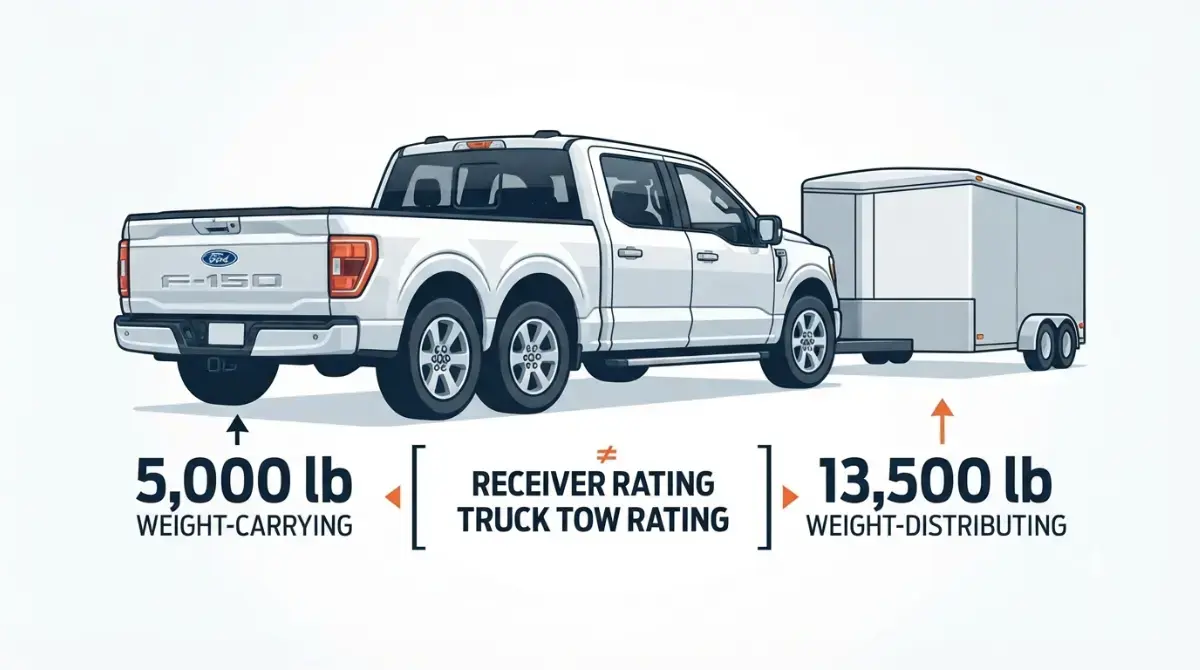
Table of Contents
Your receiver label says 5,000 lbs. The brochure says 13,500. Both are correct, and neither one is your answer by itself.
A hitch receiver rating limits one piece of hardware. Your truck’s trailer rating limits the whole vehicle. Ford publishes them separately, they move independently, and the lower one always governs.
Start where you actually are:
- Matching a trailer to a truck you own: read the receiver figures, then which limit governs.
- Sizing a build before you buy: read the receiver table and the configuration behind it.
- Comparing a used 2021–2023 against a 2024–2026: read the model-year section first, because Ford’s wording changed.
- Considering an aftermarket hitch: read the fits-but-shouldn’t section before you spend anything.
ℹ️ Safety Note: Hitch receiver limits, tow ratings, payload and tongue weight apply only to the exact build they’re published for. Exceeding any one of them affects braking and stability, not just performance. Use the figures here for comparison, then confirm each against Ford’s towing guide for your model year and your truck’s own labels before hitching a trailer.
📍 Check your own vehicle first: Specifications vary by build date, package and market, and two trucks with the same badge can be built differently. Before you buy anything based on this page, confirm against the label affixed to your hitch receiver, the Safety Compliance Certification Label on the driver’s door lock facing or latch pillar, the tire and loading placard, and your model year’s towing guide. If your vehicle disagrees with this page, your vehicle is right.
What a hitch receiver rating measures, and what it doesn’t
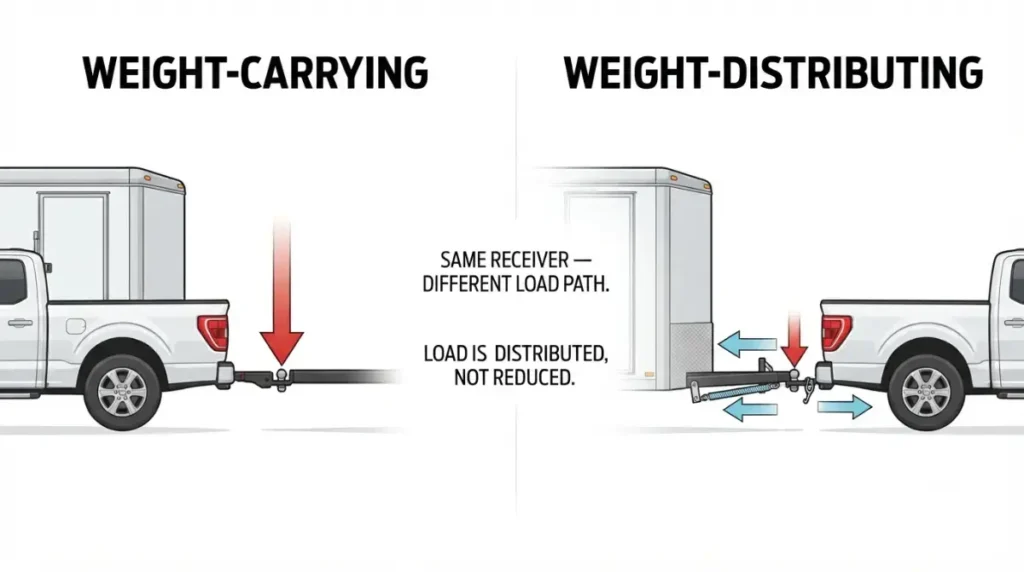
A receiver rating is a component rating. It tells you what that steel and its frame attachment are approved to handle — not what Ford permits the truck to pull.
Weight-carrying versus weight-distributing: two ratings, one piece of steel
The same receiver carries two different published capacities depending on how the trailer’s tongue load reaches it.
Weight-carrying means the tongue load sits directly on the hitch. Weight-distributing means a spring-bar system transfers part of that load forward to the front axle and back to the trailer’s own axles.
🔍 What This Spec Means: A weight-distribution system doesn’t add strength to your hitch or your truck. It changes where the load sits. That’s why the same receiver gets a higher approved capacity with one fitted — the load is spread, not reduced.
Why the trailer rating is a different number
Ford calculates trailer weight ratings using the SAE J2807 towing standard, which sets acceleration, braking, handling and sway requirements at the vehicle’s full combined weight. That’s a whole-vehicle result. The receiver rating isn’t part of it.
F-150 hitch receiver ratings, and which receiver you have
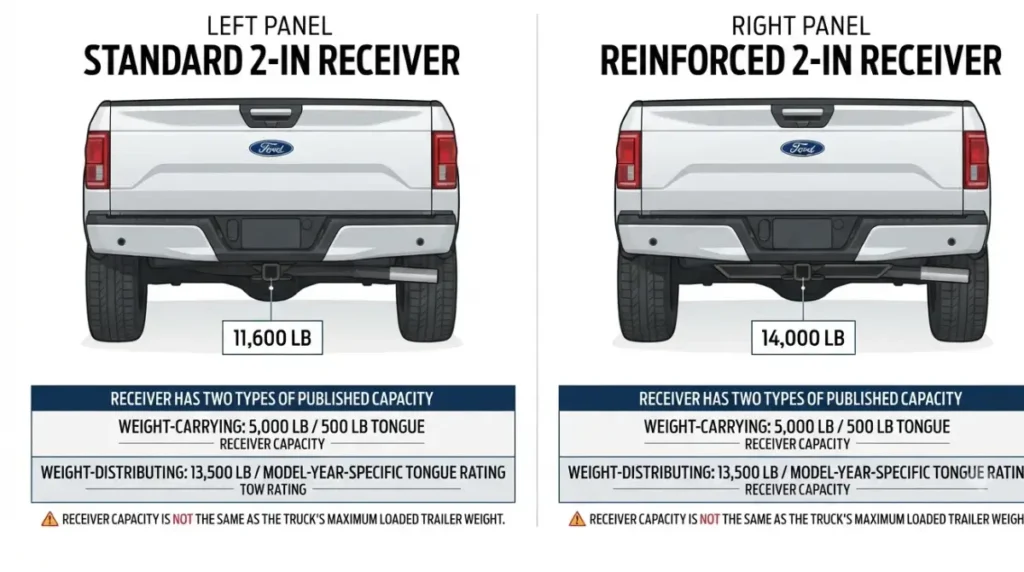
For 2026, Ford publishes one weight-carrying figure and one weight-distributing figure for the F-150 pickup, plus two different physical receivers depending on option content.
| Limit or part | 2024–2025 | 2026 | Applies To & What It Includes |
|---|---|---|---|
| Standard 2″ receiver | 11,600 lbs | 11,600 lbs | Standard on F-150 pickup |
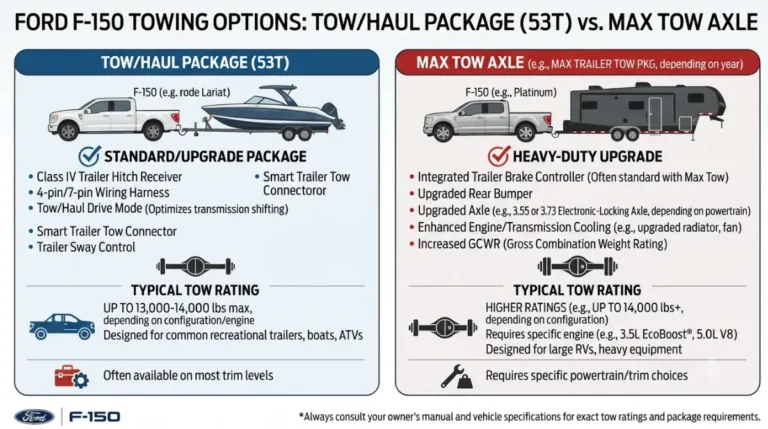
| Reinforced 2″ receiver | 14,000 lbs | 14,000 lbs | Included in 53T (2024); in the Max Tow Axle (2025–2026) |
| Weight-carrying maximum | 5,000 lbs / 500 lbs tongue | 5,000 / 500 | Any F-150 pickup towing without a weight-distribution system |
| Weight-distributing maximum | 13,500 lbs / 1,350 lbs tongue | 13,500 / 1,400 | F-150 pickup; requires Tow/Haul (53T) + Max Tow Axle |
Source: Ford 2024, 2025 and 2026 F-150 Towing Guides. Ford does not publish equivalent receiver rows for 2021–2023, so we don’t either.
What the 13,500-lb figure requires
That number isn’t standard equipment. Ford footnotes it to the Tow/Haul Package (53T) plus the optional Max Tow Axle. Without both on the build sheet, it isn’t your figure.
📐 On the Spec Sheet: Ford’s 2026 F-150 Towing Guide states directly that receiver capacities may exceed the vehicle’s maximum loaded trailer weight, and sends the reader to the Trailer Towing Selector chart instead. The sticker is a ceiling for the hardware, not permission for the truck.
To find the trailer rating for your exact build, work through the F-150 towing capacity by engine, axle and cab tables, or the full F-150 specs by configuration matrix. Both are drawn from Ford’s 2026 F-150 towing guide.
Ford’s own instruction changed between 2023 and 2026
If your truck is a 2021–2023, the rule you’ve read on a newer page may not be the rule Ford published for your model year.
What the 2023 guide says
The 2023 guide’s F-150 charts cap trailer weight at 5,000 lbs when towing with the bumper only. Separately, two footnotes cap trucks fitted with the Class IV hitch (53B) but no Trailer Tow Package (53A): 6,000 lbs on the 3.3L V6 and 2.7L EcoBoost, and 7,000 lbs on the 5.0L V8, 3.5L EcoBoost and hybrid.
What the 2026 guide says
The 2026 charts drop the bumper wording entirely. The cap is now 5,000 lbs whenever no weight-distribution system is fitted — a broader condition that catches trucks the 2023 footnotes would have permitted higher.
Which one applies to your truck
Use the guide published for your model year. We’ve verified the 2023 and 2026 documents directly; we haven’t retrieved 2021, 2022, 2024 or 2025, so we won’t name a changeover year.
⚠️ Watch Out: A forum post quoting “7,000 lbs without a weight-distribution hitch” is describing a 2021–2023 footnote tied to a specific hitch-and-package combination. Applying it to a 2026 truck, or to a 2022 truck that has package 53A, gives you a number Ford never published for that build.
The build behind the top rating moved too — see 4×4 versus 4×2 F-150 tow ratings by year. The 2023 figures above come from the 2023 Ford RV and trailer towing guide.
Which limit you actually have to obey
Four ceilings apply at once, and the lowest one that touches your load is your answer.
- Receiver rating — weight-carrying or weight-distributing, whichever matches your setup. On the receiver label.
- Maximum loaded trailer weight — your configuration’s row in the towing guide.
- GCWR — truck plus trailer combined, from the same row.
- Payload, GVWR and rear GAWR — on the Safety Compliance Certification Label.
Why payload usually runs out first
Ford sets conventional tongue load at 10% of the trailer’s loaded weight, and that load comes out of payload along with passengers, fuel and anything bolted on after the factory.
A 9,000-lb trailer puts roughly 900 lbs on the hitch before a single person climbs in. Work yours out with the F-150 payload versus tongue weight breakdown, then check it against the F-150 payload capacity chart for your engine and cab.
✅ Do This: Ask a Ford dealer towing specialist or a certified hitch installer to confirm three things in writing: the weight-carrying and weight-distributing figures printed on your receiver label, the payload remaining on your door label after accessories, and that your loaded trailer fits the selector row for your VIN.
Why a bigger aftermarket hitch doesn’t raise your tow rating
Aftermarket Class IV receivers for the F-150 are commonly published at higher weight-carrying and weight-distributing figures than the factory part, and those ratings are real ratings of that component.
Why the truck’s limit doesn’t move
Changing the receiver changes one link. Your maximum loaded trailer weight, your GCWR, your payload and your rear GAWR are vehicle ratings, published by Ford against your configuration, and a bolt-on part doesn’t renegotiate any of them.
🚫 Fits But Shouldn’t: A Class IV receiver published at 10,000 lbs weight-carrying bolts straight onto an F-150 and is genuinely rated that high as a part. It does not raise the truck’s limit. Ford’s 2026 cap of 5,000 lbs without a weight-distribution system is a vehicle instruction, and payload and rear GAWR still cap the tongue load regardless of what the hitch is stamped.
The two labels that settle this on your own truck
Every figure on this page has a physical location on your vehicle, and reading both takes about two minutes.
The label on your hitch receiver
Ford affixes a label to each receiver carrying its weight-carrying and weight-distributing capacities. It’s on the receiver itself, beneath the rear bumper.
The Safety Compliance Certification Label
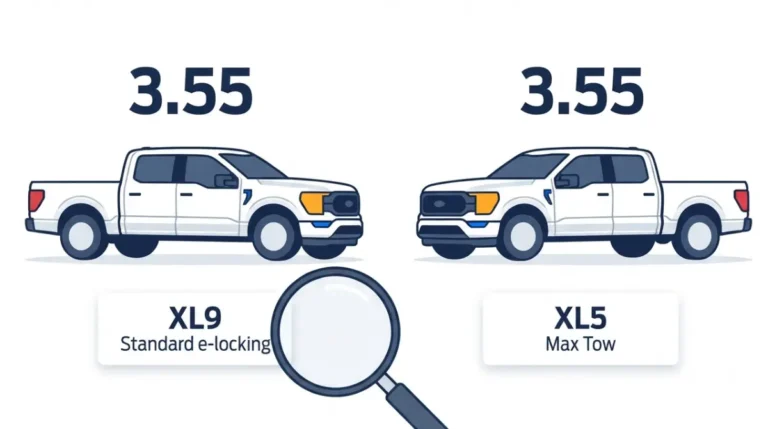
This one sits on the left front door lock facing or the door latch post pillar. It carries GVWR, rear GAWR, and a two-digit AXLE code below the bar code — 15 for 3.15, 27 or L3 for 3.31, 19 or L9 for 3.55, L6 for 3.73, L4 for 4.10. You need that code to find your row in the towing guide, alongside your model year’s owner’s manual .
F-150 hitch receiver rating: common questions
1. What is the F-150 hitch receiver rating?
For 2026, the f150 hitch receiver rating is 5,000 lbs weight-carrying with 500 lbs tongue load, or 13,500 lbs weight-distributing. Confirm on your receiver label.
2. Is the hitch receiver rating the same as the tow rating?
No. The receiver rating covers the hardware; the trailer rating covers the vehicle. Ford states receiver capacity may exceed the truck’s trailer rating. Check both.
3. What is the max tongue weight on an F-150?
Weight-carrying is 500 lbs. Weight-distributing is 1,350 lbs on 2024–2025 trucks and 1,400 lbs on 2026 trucks. Confirm on your receiver label.
4. Do I need a weight-distribution hitch on an F-150?
On 2024–2026 trucks Ford caps trailer weight at 5,000 lbs without one. The 2023 guide scopes its 5,000 lb note differently. Check your model year’s guide.
5. Will an aftermarket Class IV hitch increase my towing capacity?
No. A higher-rated receiver raises only that component’s rating. Your maximum loaded trailer weight, payload and rear GAWR are unchanged. Verify against your towing guide row.
6. Why does my hitch say 5,000 lbs if the truck tows 13,500?
5,000 lbs is the weight-carrying limit. The 13,500 lb figure needs a weight-distribution system plus Tow/Haul (53T) and the Max Tow Axle. Check your window sticker.
7. Where is the hitch rating label on an F-150?
Ford affixes a label to each receiver showing its weight-carrying and weight-distributing capacities. It’s on the receiver itself, beneath the rear bumper.
8. Does the Max Tow Axle change the receiver rating?
On 2025–2026 trucks the Max Tow Axle includes the reinforced 14,000-lb receiver. The standard receiver is rated 11,600 lbs. Confirm on your window sticker.
9. What’s the difference between weight-carrying and weight-distributing?
Weight-carrying puts tongue load directly on the hitch. Weight-distributing uses spring bars to spread that load across both truck axles and the trailer’s axles.
10. Which limit actually caps my trailer?
The lowest that applies: receiver rating, maximum loaded trailer weight, GCWR, or payload. On a half-ton, payload usually binds first. Verify all four.
Check the label before you commit
The receiver rating, the trailer rating, the GCWR and your payload are four separate ceilings, and the lowest one that touches your load is the only one that matters.
Which instruction applies depends on your model year, so use the towing guide Ford published for your truck. Then read your receiver label and your door label before you buy a trailer, a hitch, or a truck.
One Comment