F-150 weight distribution hitch limits on the factory receiver
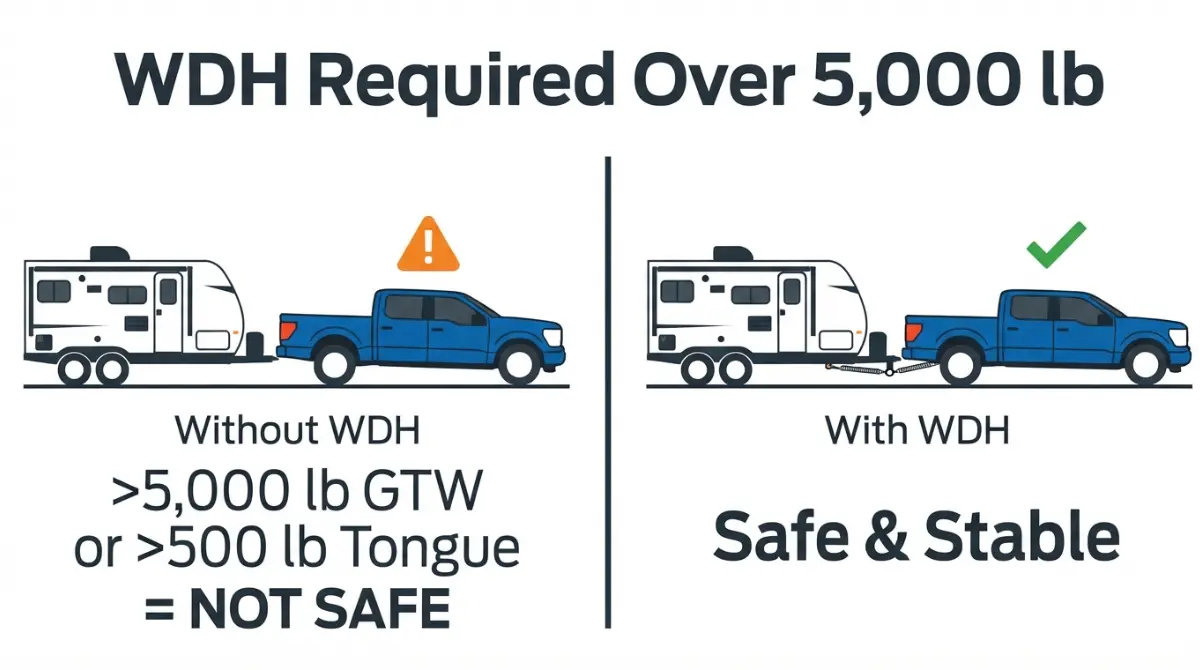
Table of Contents
Do you need a weight distribution hitch on an F-150?
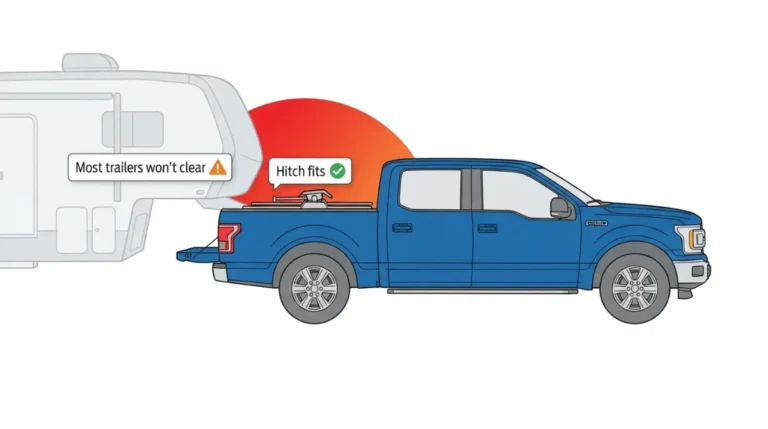
Ford rates the factory hitch receiver on the F-150 for 5,000 lb of trailer and 500 lb of tongue load on a conventional ball mount. Past either number, a weight distribution hitch is required rather than suggested.
That holds whether you are sizing a travel trailer before committing, matching a hitch system to a truck you already own, or cross-shopping 2026 builds on a dealer lot.
The trailer figure is the one everyone quotes. The tongue figure runs out first, and it does so well below 5,000 lb.
ℹ️ Safety Note: Tow ratings, tongue limits and hitch ratings depend on your exact build, and exceeding one affects steering authority and braking, not just comfort. The figures here are for comparison. Verify against the towing guide and the labels on your own truck before hitching anything.
📍 Check your own vehicle first: Specifications vary by build date, package and market, and two trucks with the same badge can be built differently. Before you buy anything based on this page, confirm against the label on your hitch receiver and the Safety Compliance Certification Label on the driver’s door lock facing. If your vehicle disagrees with this page, your vehicle is right.
Why the limit is 5,000 lb when the truck tows 13,500
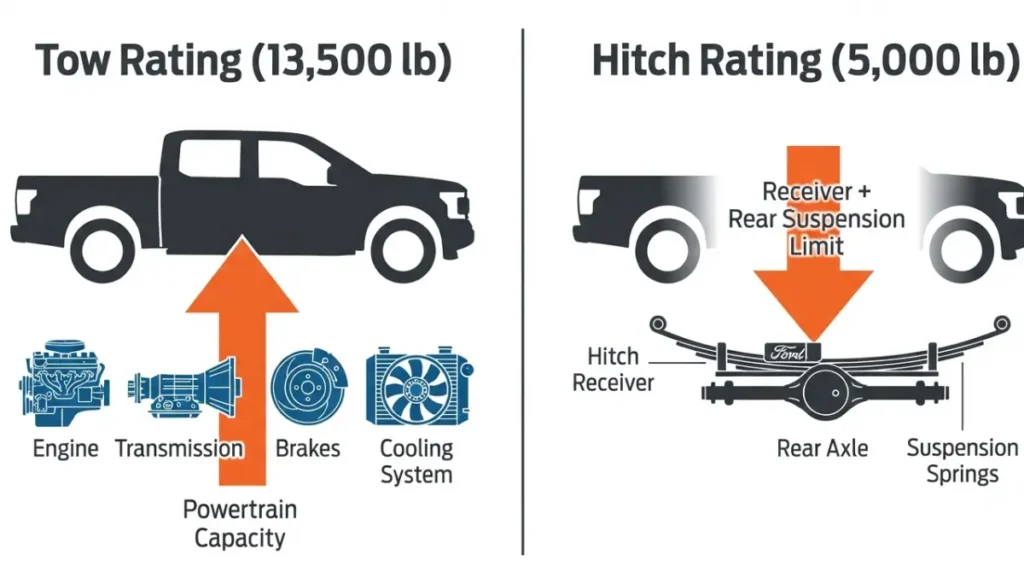
A 3.5L EcoBoost F-150 can be rated to pull 13,500 lb, and that same truck is still held to 5,000 lb on a plain ball mount. The two numbers measure different things.
The tow rating describes what the powertrain, cooling and brakes handle as a combination. The 5,000-lb figure describes what the receiver and rear suspension carry when trailer nose load sits behind the rear axle with nothing pushing back.
🔍 What This Spec Means: Hitch a trailer to a plain ball mount and weight comes off the front axle as it lands on the rear. Spring bars on a distributing hitch lever some of that load back onto the front axle, which is what restores steering and braking behaviour.
Ford’s guides carry a single weight-carrying row for the F-150 pickup, and it does not vary by engine. Comparing F-150 tow ratings by engine shows the spread; the ball-mount ceiling underneath them does not move.
What the numbers on your F-150 hitch receiver mean
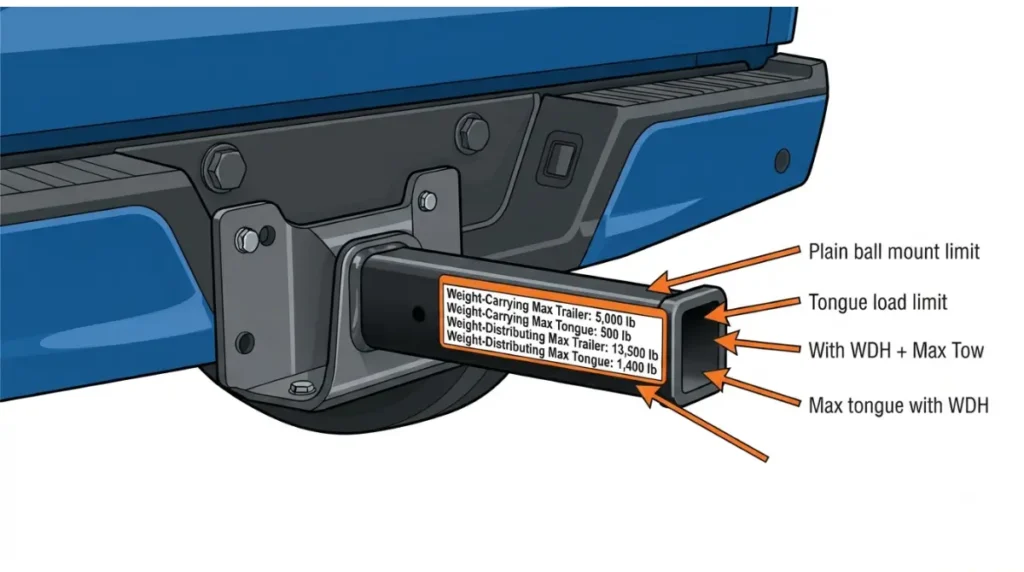
Four separate figures apply to a factory receiver, and three of them are routinely quoted as if they were the tow rating.
| Figure | Capacity | Applies To | What It Includes |
|---|---|---|---|
| Weight-carrying max trailer | 5,000 lb | 2026 F-150 pickup, every gas and hybrid engine | Conventional ball mount, no spring bars |
| Weight-carrying max tongue | 500 lb | As above | Downward load at the ball |
| Weight-distributing max trailer | 13,500 lb | 2026 F-150 with Tow/Haul Package (53T) and Max Tow Axle | Spring-bar system fitted and set up |
| Weight-distributing max tongue | 1,400 lb | As above | Downward load at the ball |
| Standard 2″ receiver rating | 11,600 lb | 2026 F-150 without Max Tow Axle | Structural rating of the receiver itself |
| Reinforced 2″ receiver rating | 14,000 lb | 2026 F-150 with Max Tow Axle | Structural rating of the receiver itself |
Source: Ford’s 2026 F-150 hitch receiver capacity chart, revised 10 March 2026.
📐 On the Spec Sheet: Ford states directly that the receiver’s maximum weight capacity may exceed the Maximum Loaded Trailer Weight for the vehicle, and directs the reader to the towing selector chart for that specific build.
The bottom two rows describe the steel, not the truck. The difference between a receiver rating and a tow rating is covered in full in how an F-150’s receiver rating relates to its tow rating.
The 500-lb tongue limit usually comes first
Ford’s guides state that tongue load should be 10% of total loaded trailer weight. At exactly 10%, the two weight-carrying ceilings land together: 500 lb of tongue on a 5,000-lb trailer.
Load the nose any heavier and the tongue limit arrives first.
| Tongue load as % of loaded trailer | Trailer weight at the 500-lb ceiling | Applies To |
|---|---|---|
| 10% | 5,000 lb | 2026 F-150, weight-carrying setup |
| 12% | approx. 4,170 lb | As above |
| 13% | approx. 3,850 lb | As above |
| 15% | approx. 3,330 lb | As above |
Arithmetic on Ford’s published 500-lb weight-carrying tongue limit. Ford’s own guidance is 10%; the heavier percentages are shown because real trailers load nose-heavy.
🚫 Fits But Shouldn’t: A 3,500-lb utility trailer sits 1,500 lb under the trailer ceiling and looks entirely safe on a ball mount. Load it at 15% on the nose and tongue weight reaches roughly 525 lb, past the 500-lb rating. The trailer weight never told you.
Tongue load also comes straight off payload, which is where most half-tons run out first — see payload versus tongue weight on the F-150.
✅ Do This: Weigh the loaded tongue at a public scale rather than calculating it from the trailer’s brochure weight. Ask for the tongue-only reading with the trailer level and coupled at towing height.
The rule isn’t identical across 2021–2026 F-150s
The 5,000-lb figure is not a constant across this generation. Option content has moved it, which is why a figure quoted for one model year cannot be carried onto another.
| Model year | What Ford’s F-150 towing guide states | Applies To | Status |
|---|---|---|---|
| 2026 | 5,000 lb / 500 lb weight-carrying; 13,500 lb / 1,400 lb weight-distributing | All F-150 pickups; the distributing row requires 53T plus Max Tow Axle | Verified |
| 2025 | Do not exceed 5,000 lb without a weight-distribution system | All F-150 pickups | Note verified; receiver chart not re-checked |
| 2024 | Do not exceed 5,000 lb without a weight-distribution system | All F-150 pickups | Note verified; receiver chart not re-checked |
| 2023 | — | Read your receiver label | |
| 2022 | A 7,000-lb ceiling appears tied to the Class IV hitch (53B) ordered without the Trailer Tow Package (53A) | 2022 builds by option code | |
| 2021 | — | Read your receiver label |
Sources: Ford’s 2026, 2025 and 2024 F-150 towing guides.
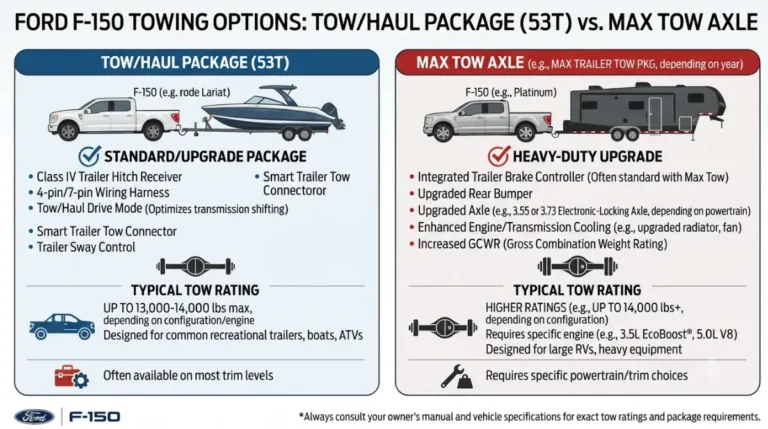
Which option code your truck carries decides which row applies, and the difference between the Tow/Haul Package and the Max Tow Axle is where that starts. Full build-by-build figures sit in the F-150 specs by configuration matrix.
Does a weight distribution hitch raise your towing capacity?
No. It changes which receiver rating applies, and nothing else.
Fitting a distributing system moves you from the weight-carrying row to the weight-distributing row on trucks equipped for it. GVWR, rear GAWR, GCWR and the Maximum Loaded Trailer Weight for your build are unchanged, and Ford’s guides state that combined vehicle and trailer weight cannot exceed the listed GCWR.
🚫 Fits But Shouldn’t: Replacement Class IV receivers are sold with weight-carrying ratings of 6,000 to 10,000 lb and bolt to the same frame. The higher number describes the aftermarket part, not the truck. GCWR, rear GAWR and the Maximum Loaded Trailer Weight in Ford’s selector chart are unaffected by which receiver is bolted on.
⚠️ Watch Out: The spring bars, head and shank all hang on the receiver, so a distributing system consumes some of the tongue allowance it unlocks and comes off payload as well. Check the system’s published weight against your door-jamb figure before ordering.
Where to find your F-150’s actual hitch numbers
Four locations settle this for your specific truck.
- The label on the receiver — carries the weight-carrying and weight-distributing trailer and tongue capacities for the receiver fitted to your truck.
- The Safety Compliance Certification Label — on the left front door lock facing or the door latch post pillar; carries GVWR, GAWR and the two-digit axle code.
- The tire and loading placard — available payload for that truck as built.
- The window sticker or build sheet — which tow option code was ordered.
✅ Do This: Write down four numbers before you shop: the receiver’s weight-carrying tongue limit, its distributing tongue limit, your available payload, and your build’s Maximum Loaded Trailer Weight. Any trailer you consider has to clear all four.
F-150 weight distribution hitch questions
1. Does Ford require a weight distribution hitch over 5,000 lb?
Yes. Ford’s F-150 towing guides state trailer weight must not exceed 5,000 lb without a weight-distribution system. Confirm on your receiver label.
2. Can an F-150 tow 7,000 lb without one?
Not on a 2024–2026 truck. The weight-carrying ceiling is 5,000 lb regardless of engine. Check your receiver label for older builds.
3. What is the max tongue weight on an F-150 without a weight distribution hitch?
500 lb on the 2026 weight-carrying rating. Above that a distributing system is required. Verify on your receiver label.
4. Is the 5,000-lb limit different by engine?
No. Ford lists one weight-carrying row for the F-150 pickup, so a 2.7L and a 3.5L share the same ceiling.
5. Does a weight distribution hitch increase F-150 towing capacity?
No. It changes which receiver rating applies. GVWR, GCWR and Maximum Loaded Trailer Weight stay the same. Check your door-jamb label.
6. Where is the hitch rating on an F-150?
On a label affixed to the hitch receiver, showing both weight-carrying and weight-distributing capacities for that receiver.
7. What does the 11,600 lb figure mean?
It is the structural rating of the standard 2″ receiver, not a tow rating. Your build’s towing figure comes from the selector chart.
8. Do I need the Max Tow Axle for 13,500 lb?
Yes. Ford footnotes the 13,500 lb weight-distributing figure as requiring the Tow/Haul Package (53T) plus the optional Max Tow Axle.
9. Does an aftermarket receiver raise the limit?
No. A higher-rated receiver does not change GVWR, rear GAWR, GCWR or your build’s Maximum Loaded Trailer Weight. Verify against your certification label.
10. Is the rule the same for every year from 2021?
No. The 2022 guide ties a 7,000-lb ceiling to one option code. Read your own receiver label.
Before you buy the trailer
The 5,000-lb rule is a receiver limit, not an engine limit, and the 500-lb tongue figure beside it is the one that binds first on any nose-heavy load. Read both off the label on your own receiver, check them against your available payload, and treat the brochure tow rating as the last number to matter, not the first.