F-150 Generations by Year and the Full 12th–14th Gen Split
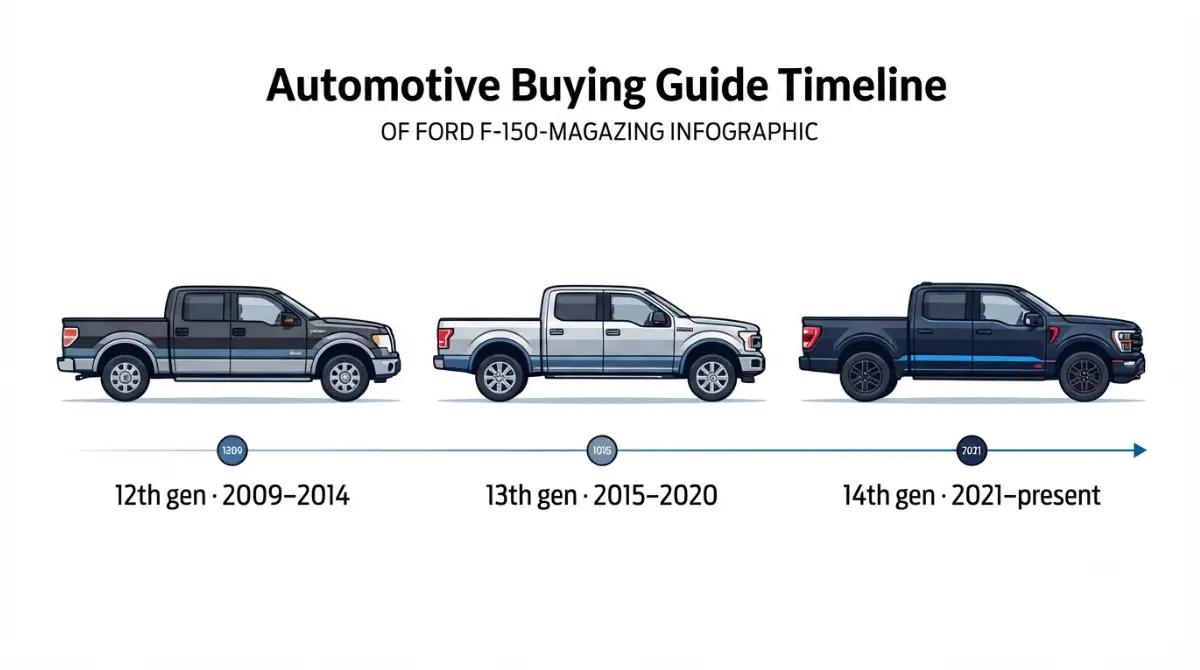
Table of Contents
Which F-150 generation is the truck you’re looking at?
Since 2009 the F-150 has had three generations. The 12th generation covers model years 2009–2014, the 13th covers 2015–2020, and the 14th covers 2021 onward. Inside each generation, a break year changes engines or transmissions, so the generation label alone doesn’t tell you what you’re buying.
The short answer: three generations since 2009
Start with your situation:
- Cross-shopping used trucks: read the generation sections, then the year traps, before you visit a lot.
- Matching a part to a truck you own: go to the parts section and match the specs it names.
- Checking reliability by year: that’s an ownership question. It’s covered in F-150 problems by year on our sister site, The Throttle Times.
Why the model year alone can mislead you
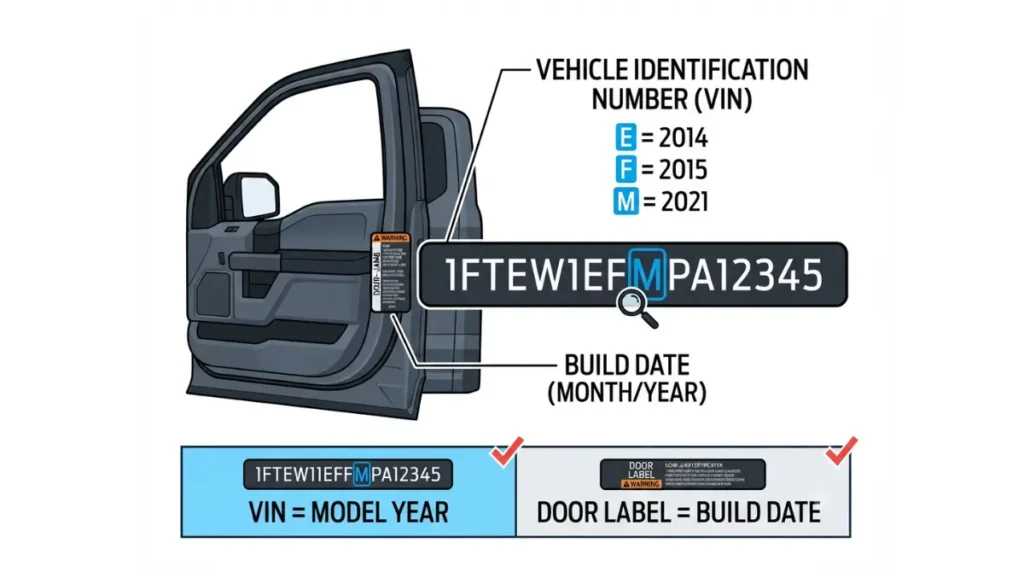
Model year and build date aren’t the same thing. A truck assembled in late 2014 can be a 2015 model. The VIN settles the model year, and the door-jamb label settles the build date.
ℹ️ Safety Note: Wheels and tires are load-rated equipment. A wheel from another generation or trim can bolt on and still be rated below what your truck needs. Confirm every wheel and tire rating against your own truck’s tire and loading placard before buying.
📍 Check your own vehicle first: Specifications vary by build date, package and market, and two trucks with the same badge can be built differently. Before you buy anything based on this page, confirm against the VIN (position 10), the door-jamb certification label, and the window sticker or build sheet. If your vehicle disagrees with this page, your vehicle is right.
F-150 generations at a glance: years, build dates, VIN codes
The F-150 has had three generations since 2009: the 12th (2009–2014), the 13th (2015–2020), and the 14th (2021–present).
Generation boundary table
| Generation | Applies To (model years) | Production began | Body | VIN position 10 |
|---|---|---|---|---|
| 12th | 2009–2014, all cabs and engines | October 2008 | Steel body and bed | 9, A, B, C, D, E |
| 13th | 2015–2020, all cabs and engines | November 2014 | Aluminum-intensive | F, G, H, J, K, L |
| 14th | 2021–2027, all cabs and engines | October 2020 | Aluminum-intensive | M, N, P, R, S, T, V |
Sources: VIN year codes from 49 CFR 565.15, Table VII. Model-year ranges and production starts come from secondary records; the should confirm them against the Ford Media Center. The 2027 row reflects the 14th generation continuing, per reporting on Ford’s 2027 order guide
📐 On the Spec Sheet: Federal VIN rules (49 CFR 565.15, Table VII) assign position 10 to the model year. E means 2014, F means 2015, L means 2020, M means 2021, R means 2024, and V means 2027. The letter U is skipped.
The mid-cycle break years inside each generation
- 12th gen: 2011 powertrain change.
- 13th gen: 2017 (10-speed on select models) and 2018 (refresh, new engines, diesel added mid-year).
- 14th gen: 2024 (refresh, 2.7L base engine) and 2027 (3.0L base engine, reported).
12th-gen F-150 (2009–2014): the last steel-body trucks
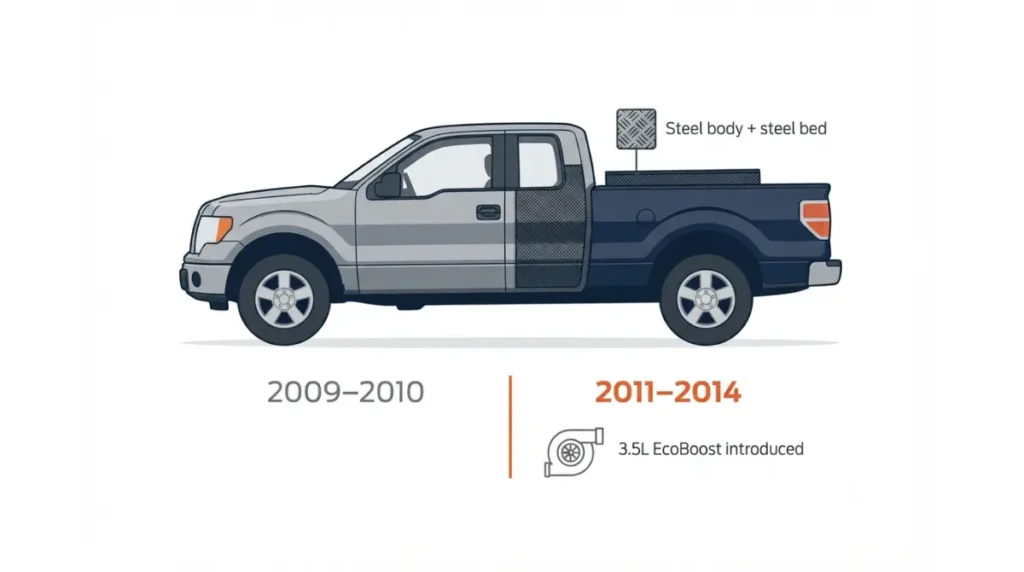
The 12th-gen F-150 was the last one built with a steel body and a steel bed. That matters when you price body panels or a used bed.
2009–2010 vs 2011–2014 powertrain split
The break inside this generation is the 2011 model year, when the engine lineup changed and the 3.5L EcoBoost arrived.
SVT Raptor years inside this generation
The original SVT Raptor was introduced for 2010 and ended with the 2014 model year. The next Raptor didn’t arrive until 2017, which creates one of the listing traps covered below.
13th-gen F-150 (2015–2020): aluminum body and the 2018 break
The 2015 redesign changed the material under the paint and reset the engine lineup.
The 2015 aluminum-intensive body
For 2015, Ford moved the F-150 to an aluminum-intensive body. Ford said the redesign shed up to 700 lb. The same year introduced the 2.7L EcoBoost with standard Auto Start-Stop.
2017–2018: the 10-speed and new engines
Select 2017 models got the 10-speed automatic, and it replaced the six-speed across the lineup for 2018.
- 2015–2016: six-speed automatic
- 2017: 10-speed on select models, six-speed on the rest
- 2018–2020: 10-speed across the lineup
For 2018, a 3.3L V6 replaced the naturally aspirated 3.5L V6. The 3.0L Power Stroke diesel arrived partway through the 2018 model year. Per Ford’s 2018 F-150 engine fact sheet. retail buyers could order it on Lariat, King Ranch and Platinum SuperCrew and SuperCab builds.
Where the Raptor went (and came back)
There is no 2015 or 2016 Raptor. The F-150 Raptor returned for 2017 on this generation’s platform.
14th-gen F-150 (2021–present): 2024 refresh and 2027 changes
The current generation splits into three buying phases.
2021–2023: launch lineup
Production of the 14th-gen F-150 began in October 2020 for the 2021 model year. The 3.3L V6 stayed as the base engine through 2023. Our 14th-gen F-150 specs by configuration break down each build, and you can see which engines each trim offers.
2024 refresh: 2.7L becomes base
For 2024, Ford dropped the 3.3L V6 and made the 2.7L EcoBoost standard, rated at 325 hp and 400 lb-ft. Platinum Plus replaced Limited at the top of the range. Details are in Ford’s 2024 F-150 media materials.
2027: 3.0L EcoBoost replaces the 2.7L
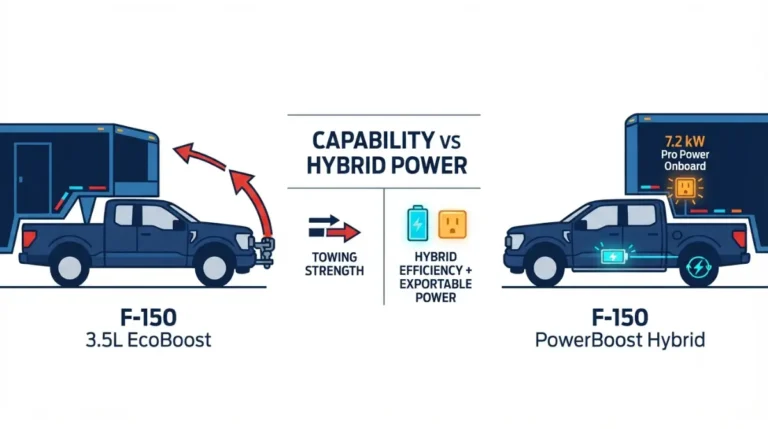
Reports of Ford’s 2027 order guide list a 3.0L EcoBoost (option code 99C) as the new base engine, with the 2.7L deleted. The same reports show the 5.0L V8 returning to King Ranch and Platinum, where 2026 trucks offered only the 3.5L EcoBoost and PowerBoost. Ford hasn’t announced a next generation, so the 2027 model year remains 14th gen.
Do F-150 parts carry across generations?
A generation label on a part listing is a starting point, not a fitment claim.
Specs to match before any wheel crosses generations
Before moving a wheel between generations, or from a Raptor, match each of these against your own truck:
- bolt pattern and hub bore
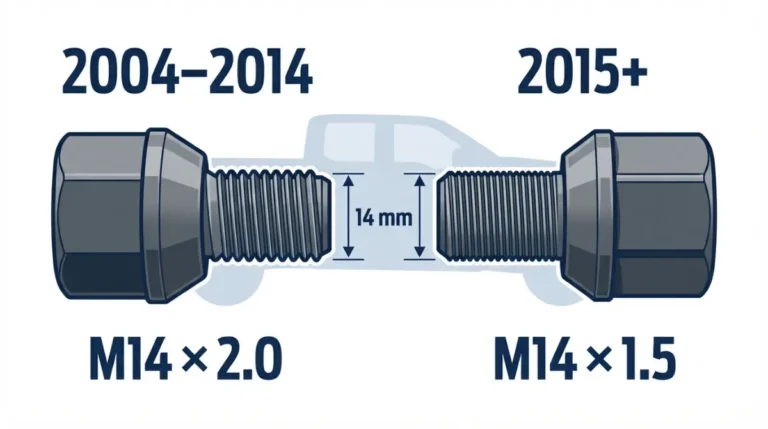
- lug thread pitch and seat type (see our F-150 lug nut size and thread pitch guide)
- the wheel’s load rating, measured against your placard
- offset and brake clearance
🚫 Fits But Shouldn’t: A wheel with the right bolt pattern can still carry a load rating below what your truck requires. It installs, torques down and looks correct. The number that settles it is the wheel’s rated load compared with your tire and loading placard.
Body panels and beds: steel vs aluminum
12th-gen trucks use steel, and 13th-gen trucks moved to aluminum-intensive construction. Check any bed, panel or cover against its stated model-year range. See how tonneau cover fit changes by F-150 generation.
Capability doesn’t carry over
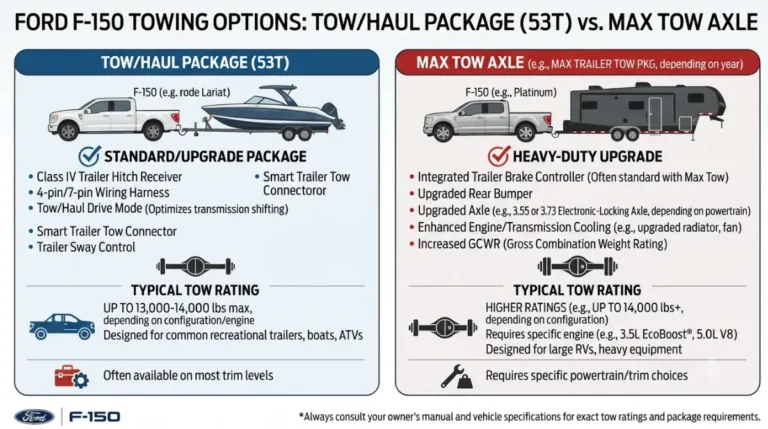
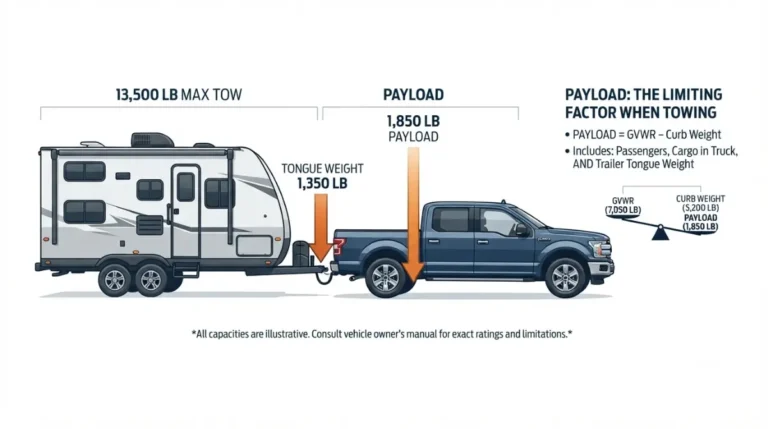
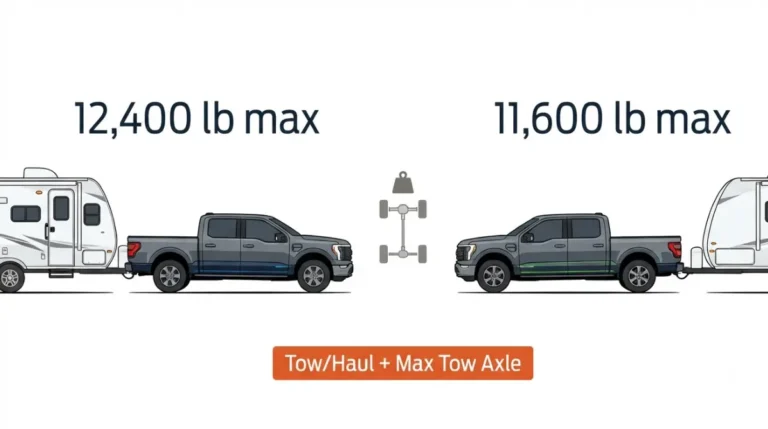
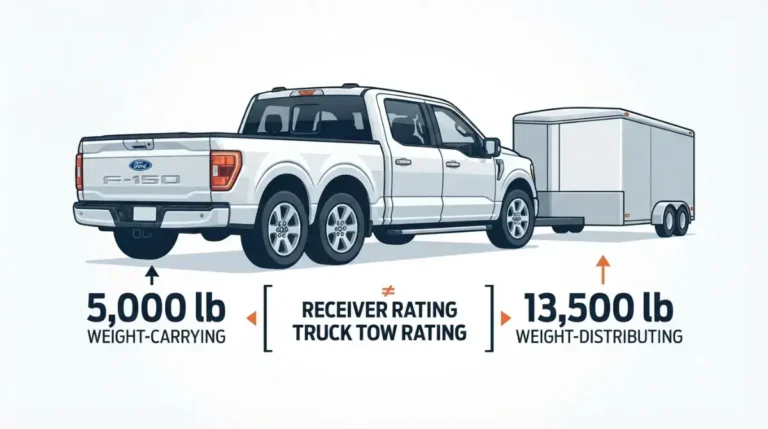
Tow and payload ratings belong to an engine, axle, cab and package, not to a generation. Check your build in the F-150 towing capacity by engine chart.
✅ Do This: Before fitting wheels from another generation or trim, ask a tire shop or Ford service department to confirm four things against your VIN: bolt pattern, hub bore, lug thread pitch, and the wheel’s load rating versus your placard.
Year traps that mislabel F-150s, and how to check yours
Most mislabeled listings fall into three traps.
Build date vs model year
13th-gen production began in November 2014, so a 2015 truck can carry a 2014 build date.
🚫 Fits But Shouldn’t: A “2014 aluminum F-150” listing is wrong. Every 2014 model-year F-150 is 12th gen, steel body and bed, and VIN position 10 reads E.
The Raptor that doesn’t exist (2015–2016)
A 2015 or 2016 “Raptor” is mislabeled. Check the VIN.
Read the VIN 10th character and door-jamb label
- Read VIN position 10 and match it to the table, using the federal VIN model-year code table.
- Read the production month and year on the door-jamb certification label.
- Confirm the engine and transmission on the window sticker or build sheet.
FAQ
1. What years are the 13th gen F-150?
The 13th gen F-150 covers model years 2015–2020, with an aluminum-intensive body and a mid-cycle break for 2018.
2. What year did the F-150 go aluminum?
The F-150 went aluminum-intensive for the 2015 model year, and Ford said the redesign shed up to 700 lb.
3. Is a 2014 F-150 aluminum?
No. A 2014 model-year F-150 is 12th gen with a steel body and bed, and VIN position 10 reads E.
4. Which F-150 years have the 10-speed?
Select 2017 F-150 models got the 10-speed automatic, and from 2018 it replaced the six-speed across the 13th-gen lineup.
5. Was there a 2015 F-150 Raptor?
No. The SVT Raptor ended with 2014, and the F-150 Raptor returned for 2017, so 2015–2016 Raptors don’t exist.
6. What changed on the 2024 F-150?
The 2024 F-150 refresh dropped the 3.3L V6, made the 2.7L EcoBoost standard, and replaced Limited with Platinum Plus.
7. Is the 2027 F-150 a new generation?
No. The 2027 F-150 remains 14th gen, and reported order-guide changes make a 3.0L EcoBoost the base engine.
8. How do I tell what year my F-150 is?
Read position 10 of the F-150’s VIN: F means 2015, M means 2021, R means 2024. The door-jamb label shows the build date.
9. Do 13th and 14th gen F-150 parts interchange?
Only when the specs match. For F-150 wheels, compare bolt pattern, hub bore, thread pitch and load rating, not the generation label. Confirm against your placard and VIN before buying.
10. When is the next F-150 generation coming?
Ford hasn’t announced the next F-150 generation. The 2027 model year remains 14th gen, so treat redesign dates as unconfirmed.
Your F-150 generation check in one line
Three generations cover 2009 onward: 12th (2009–2014), 13th (2015–2020) and 14th (2021–present). The years that change what you’re buying are 2011, 2017–2018, 2024 and 2027. Before you pay for a truck or a part, read VIN position 10, the door-jamb label and the window sticker, then check the exact configuration in our pillar.