Used F-150 Lightning specs by battery and package, 2022–2025

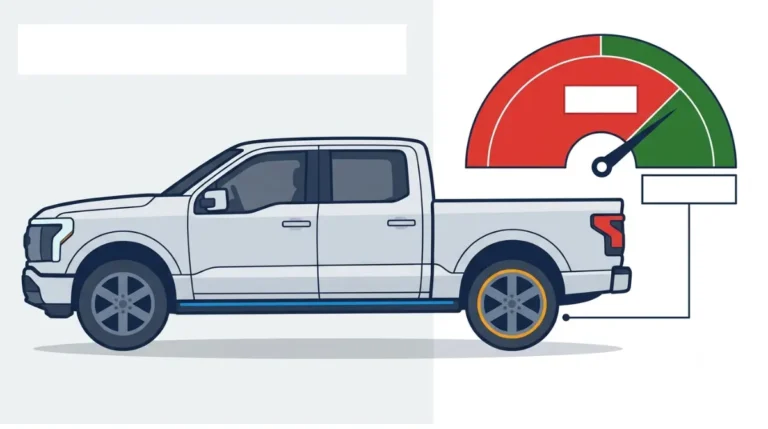
On a 2025 F-150 Lightning Flash, 300 miles and 536 hp mean the 123 kWh pack. Charger, payload and Max Trailer Tow limits for used trucks, by year and pack.
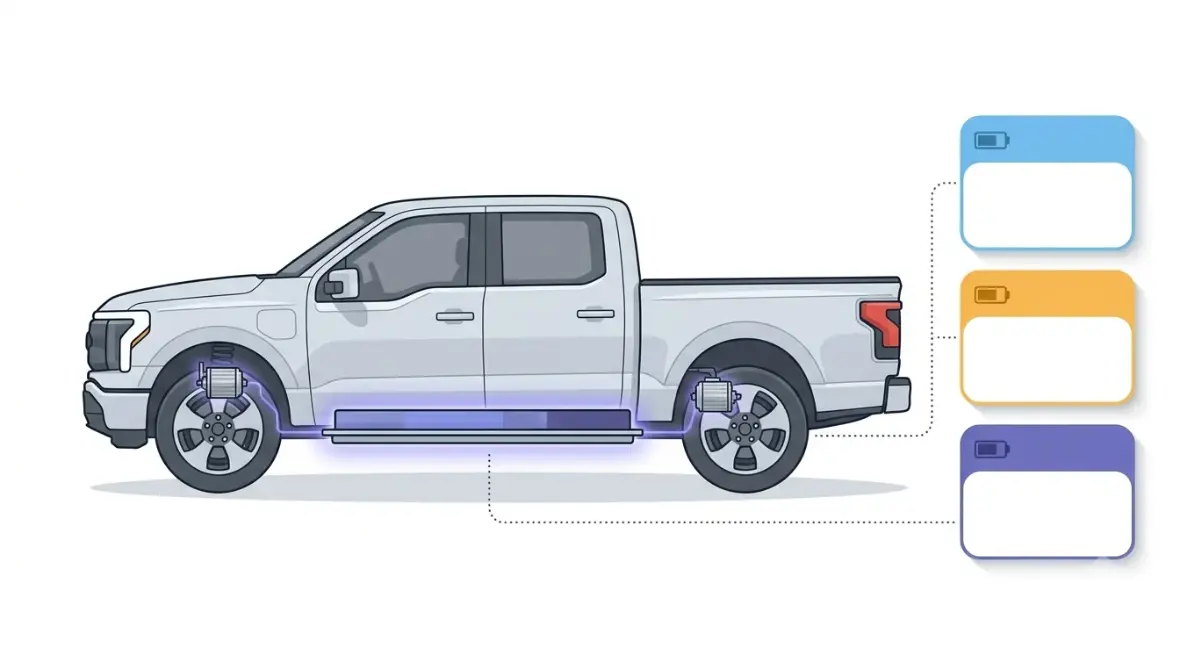
Table of Contents
A used 2022–2025 F-150 Lightning carries one of three usable battery sizes, 98, 123 or 131 kWh, and the pack sets its horsepower, EPA range, tow rating and payload more than the trim badge does. The model year sets home charging: Extended Range trucks from 2022 and 2023 have a 19.2 kW onboard charger, and from 2024 Ford lists that charger for fleet builds only.
All of them are SuperCrew trucks with a 5.5-foot bed and two motors, so cab, bed and drive never change the answer. Ford no longer takes orders for the current truck, according to Ford’s F-150 Lightning page, and a Ford executive said in December 2025 that production of the 2025 model-year Lightning had ended.
Three battery packs across four model years
Through 2024, Ford built the Lightning with two packs. Its 2025 specification lists a third, a 123 kWh Extended Range battery that sits between the other two.
| Pack (usable) | Peak output | EPA-estimated range | Retail trims that carry it | Model years |
|---|---|---|---|---|
| 98 kWh Standard Range | 452 hp, 775 lb-ft | 230 mi (2022); 240 mi (2023–2025) | Pro, XLT and Lariat (2022–23); Pro and XLT (2024–25) | 2022–2025 |
| 131 kWh Extended Range | 580 hp, 775 lb-ft | 320 mi; 300 mi on Platinum | XLT and Lariat as an option, Platinum standard (2022–23); Flash, Lariat and Platinum (2024); Lariat and Platinum (2025) | 2022–2025 |
| 123 kWh Extended Range | 536 hp, 775 lb-ft | 300 mi | Flash | 2025 |
Sources: Ford’s 2022, 2023, 2024 and 2025 F-150 Lightning technical specifications; the Ford Media Center note on the 240-mile rating for Standard Range trucks built from fall 2022.
Two rows carry a catch. A Platinum rated at 300 miles still has the 131 kWh battery; Ford rates it 20 miles below a Lariat on the same pack.
The Pro shows up with an Extended Range pack in every year, but only as a fleet build. A Pro listing that claims 320 miles is one of those trucks or a typo, and its window sticker settles which.
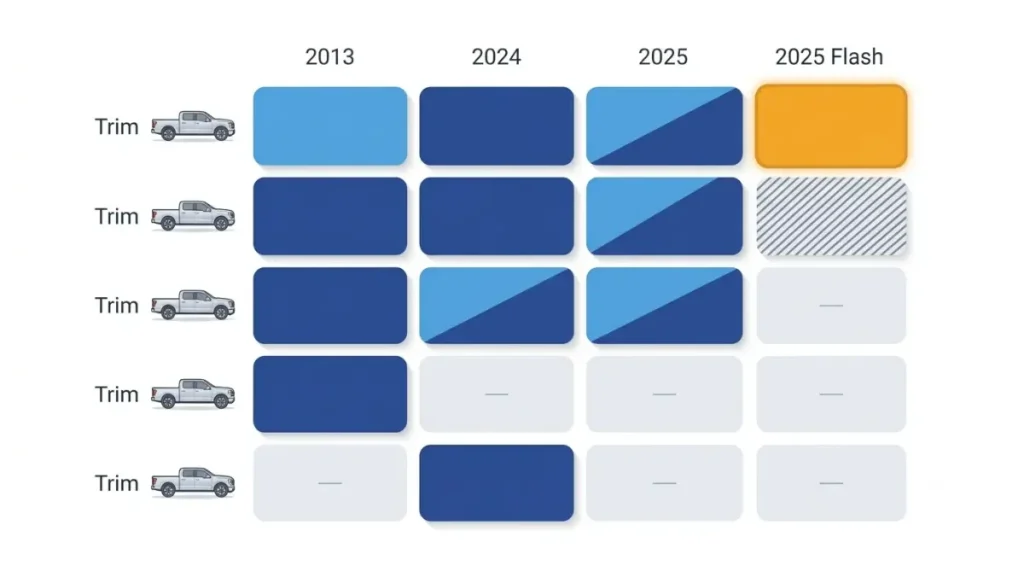
The 2024 change is easy to miss on a listing. Ford dropped the Extended Range option from the 2024 XLT and gave the new Flash trim the larger battery instead, so a 2024 XLT is a 98 kWh truck. The rest of the 2021–2026 F-150 lineup sits in F-150 specs by configuration.
2025 Flash: the 123 kWh trap
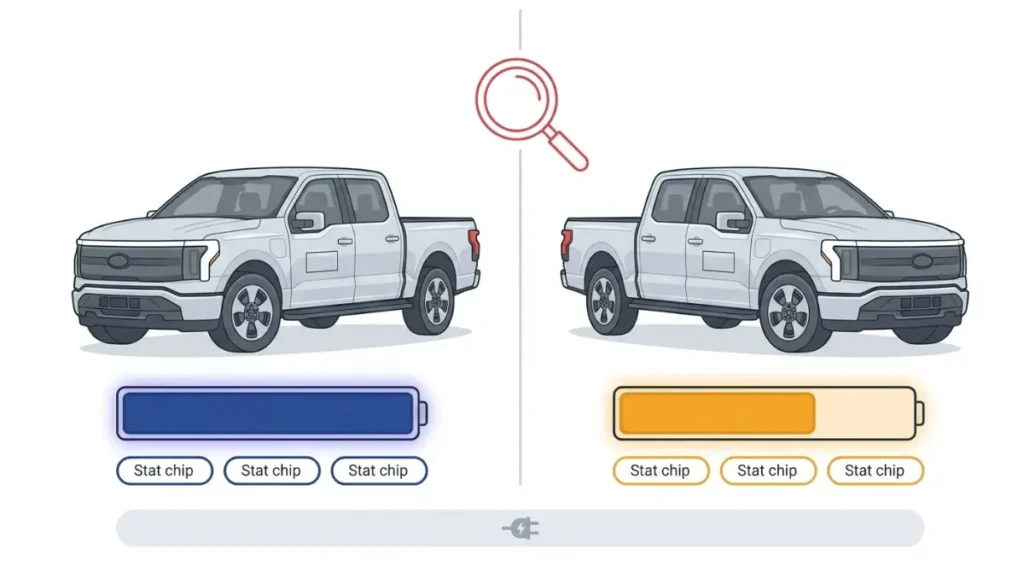
Two Flash listings can share a badge and the words “Extended Range” while holding different packs. Ford’s 2024 sheet puts the Flash on the 131 kWh battery, with 580 hp and an EPA-estimated 320 miles. Its 2025 sheet puts the Flash on the 123 kWh battery: 536 hp and 300 miles.
Ford’s 2025 Lightning page gives the split in its own words: “536 HP with 123kWh battery; 580 with available 131kWh battery.”
Both batteries carry the same 38-minute estimate for a 15–80% DC fast charge on the 2025 sheet, so charging speed won’t separate them. A listing that reads only “Flash, Extended Range” hasn’t told you which battery is under the floor. Compare its price only against Flashes carrying the same pack.
Which pack is in the truck you’re looking at?
The Monroney sticker answers it in one line. Its EPA label prints the truck’s driving range on a full charge (fueleconomy.gov label guide), and on a Lightning each range figure points to one pack.
| What the sticker or listing shows | Pack it points to | Applies to |
|---|---|---|
| 230 or 240 mi; 452 hp | 98 kWh | Pro, XLT, Lariat (2022–23); Pro, XLT (2024–25) |
| 320 mi; 580 hp | 131 kWh | XLT, Lariat (2022–23); Flash, Lariat (2024); Lariat (2025); Pro fleet builds |
| 300 mi on a Platinum | 131 kWh | Platinum, 2022–2025 |
| 300 mi or 536 hp on a Flash or Pro | 123 kWh | Flash and Pro fleet builds, 2025 |
Sources: the Ford specification sheets linked under the battery table.
The 300-mile row is where a 2025 Flash gives itself away: on that trim and year, 300 miles and 536 hp mean the 123 kWh battery.
Check your own truck: ask the seller for the sticker that belongs to that VIN. If the original is gone, ask a Ford dealer to pull the truck’s original build by VIN and read you its battery and EPA range.
Home charging speed changed in 2024
Eight hours against thirteen. Those are Ford’s 15–100% estimates on an 80-amp Ford Charge Station Pro for a 131 kWh truck from 2023 and one from 2025, and the gap comes from the onboard charger.
| Model years | Pack | Onboard charger (input) | 15–80% DC fast charge, 150 kW |
|---|---|---|---|
| 2022–2023 | 98 kWh | 11.3 kW (48 A) | 44 min |
| 2022–2023 | 131 kWh | 19.2 kW (80 A) | 41 min |
| 2024 | 98 kWh | 11.3 kW (48 A) | 32 min |
| 2024 | 131 kWh | 19.2 kW (80 A) listed as fleet only | 38 min |
| 2025 | 98, 123 or 131 kWh | 11.3 kW (48 A); 19.2 kW fleet only, 131 kWh | 32 min (98); 38 min (123, 131) |
Sources: Ford’s 2022 sheet, 2023 sheet, its 2024 sheet and its 2025 sheet.
The 2025 sheet spells out 11.3 kW for retail trucks on all three packs, so on a 2025 retail truck an 80-amp wall unit delivers no more than the onboard charger’s 48-amp intake. Ford’s 2024 sheet names only the fleet 19.2 kW unit for the larger pack.
Ford included the Charge Station Pro with 2022 and 2023 Extended Range trucks when new, and for 2024 it became an accessory for both packs. If a seller hands one over with a 2022–23 truck on the larger pack, that truck can use its full output.
Pro Power Onboard moved in 2024 as well. A 2022–23 Lariat has the 9.6 kW system as standard; from 2024 the Lariat came with 2.4 kW standard and 9.6 kW as an option, which left the Platinum as the only trim with 9.6 kW standard. What each output can run is covered in what 2.4 kW and 9.6 kW Pro Power Onboard can power.
What each pack can tow and carry
Every number in this table is a ceiling for one build Ford names. Ford’s sheets add that towing and payload “may not be achieved simultaneously.”
| Model years and pack | Max payload, and the build Ford quotes it for | Towing without the package | With Max Trailer Tow Package |
|---|---|---|---|
| 2022–2023, 98 kWh | 2,235 lb (Pro) | 5,000 lb | 7,700 lb |
| 2022–2023, 131 kWh | 1,952 lb (XLT 312A) | 7,700 lb | 10,000 lb XLT, Lariat; 8,500 lb Platinum |
| 2024, 98 kWh | 2,235 lb (Pro) | 5,000 lb | 7,700 lb |
| 2024, 131 kWh | 1,913 lb (Flash) | 7,700 lb | 10,000 lb Flash, Lariat; 8,500 lb Platinum |
| 2025, 98 kWh | 2,329 lb (Pro) | 5,000 lb | 7,700 lb Pro, XLT |
| 2025, 123 kWh | 2,246 lb (build not named) | 7,700 lb | 10,000 lb Flash, Pro fleet |
| 2025, 131 kWh | 1,879 lb (build not named) | 7,700 lb | 10,000 lb Lariat, Pro fleet; 8,600 lb Platinum |
Sources: capability tables and footnotes in Ford’s 2022, 2023, 2024 and 2025 Lightning specifications.
A Platinum stops at 8,500 lb (8,600 lb for 2025) even with Max Trailer Tow, and a Standard Range truck stops at 7,700 lb with it. The 10,000-lb figure belongs to Extended Range builds below Platinum that have the package, so check that the package appears on the truck’s sticker before you price a trailer.
Payload for the truck you’re buying is printed on the Tire and Loading Information placard on the driver’s door jamb, and Ford’s footnotes point there for a specific vehicle. That placard figure is the one to work from; the table only shows how high each build can go.
Before you hitch: the placard payload has to cover the trailer’s tongue weight plus everyone and everything in the truck, and the hitch receiver carries its own limit. Ask the hitch installer to read you the receiver’s class and maximum tongue weight off its label before you buy a trailer sized to a brochure figure. How tongue weight comes out of payload is worked through in how tongue weight eats into payload, and receiver limits in the receiver’s rating against the truck’s tow rating.
Get the window sticker before you pay
Ask the seller for the window sticker by VIN and read four lines on it before any money changes hands:
- The battery and its EPA range, matched against the tables earlier on this page.
- Max Trailer Tow Package, if you plan to tow anything heavier than 5,000 lb with a Standard Range truck or 7,700 lb with an Extended Range one.
- Pro Power Onboard output, 2.4 kW or 9.6 kW.
- On a 2024–25 truck, any 19.2 kW onboard charger line, which Ford lists for fleet builds only.
Two checks sit outside the sticker. Ford covers the high-voltage battery and EV components for 8 years or 100,000 miles from the original warranty start date, including a clause for capacity falling below 70% (Ford’s F-150 Lightning page), and a Ford dealer can give you that start date, which sets how much coverage is left. Open recalls for the truck show up when you run its VIN through NHTSA’s recall lookup.
Found this helpful? See more of our guides on Google.
Want to see our guides first on Google?