
F-150 payload and tongue weight, by engine and hitch type
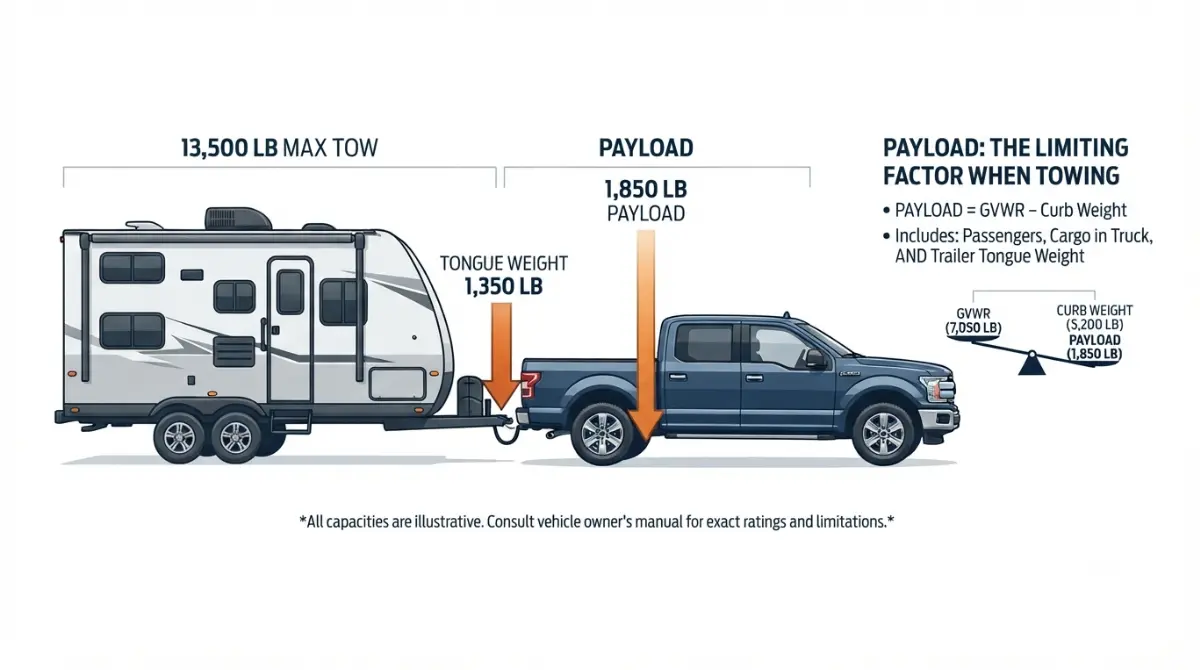
Table of Contents
The number that stops you isn’t the tow rating
Three buyers land here. Cross-shopping configurations before you order, the payload table below is yours. Matching a specific trailer to a truck you already have, start at the hitch section, then the verification section at the end.
Comparing a used 2021 truck against a new one, the model-year section explains why the figures moved.
Which number applies to you
The 13,500 lb figure you have seen is a tow rating. It is rarely what runs out first. What usually runs out first is payload — and your trailer’s tongue weight is charged to it.
What this article resolves
Ford’s 2026 towing guide states that horsepower, torque, payload and towing are independent attributes that may not be achieved simultaneously. The two headline maximums belong to two different trucks.
ℹ️ Safety Note: Payload, tongue weight, GVWR and rear GAWR are rated limits, not targets. Exceeding one changes braking and stability, not just comfort. Every figure here is for comparison between configurations; the figures for your truck are on its own labels, and no section of this article has been reviewed by a qualified technician.
📍 Check your own vehicle first: Specifications vary by build date, package and market, and two trucks with the same badge can be built differently. Before you buy anything based on this page, confirm against the Tire and Loading Information placard on the driver’s-side B-pillar and the Safety Compliance Certification Label beside it. If your vehicle disagrees with this page, your vehicle is right.
What payload and tongue weight each actually mean
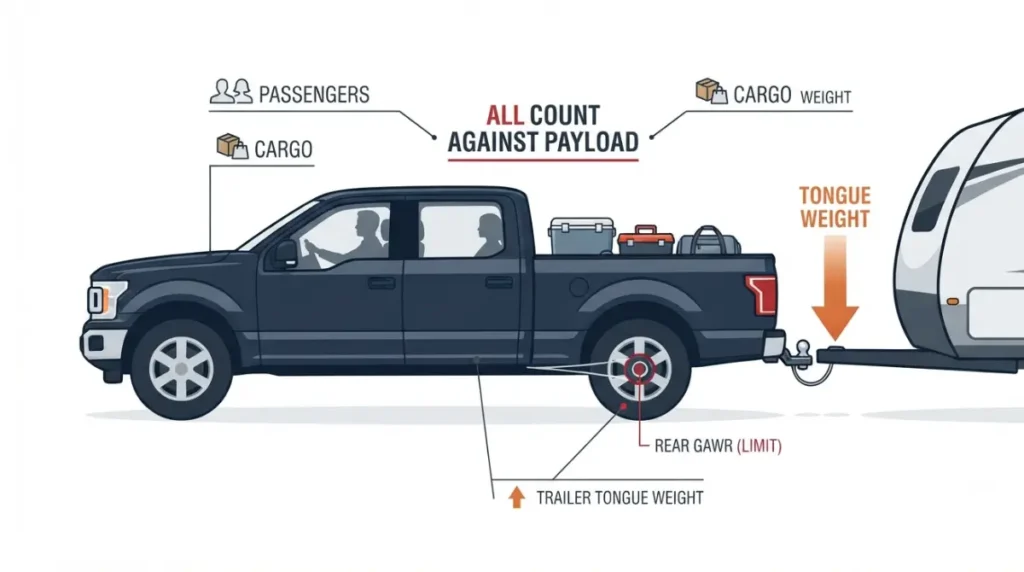
Payload is not bed cargo. It is everyone in the cab, everything in the bed, every accessory added after the truck was built, and the downward load your trailer puts on the hitch.
Why tongue weight comes out of payload
That load lands almost entirely on the rear axle, which is why rear GAWR can bind before GVWR does.
📐 On the Spec Sheet: Ford’s 2026 F-150 Towing Guide instructs that vehicle payload, reduced by option weight, must accommodate trailer tongue load plus passengers and cargo, and that the total must not push the truck past rear GAWR or GVWR. It states these ratings are on the Safety Compliance Certification Label. Ratings are calculated with the SAE J2807 method.
The 10% figure Ford publishes
Ford’s F-150 guides state that conventional trailer tongue load should be 10% of total loaded trailer weight. The 15% figure in the same guides applies to a 5th-wheel king pin, not a bumper-pull tongue.
Running the subtraction on your own number
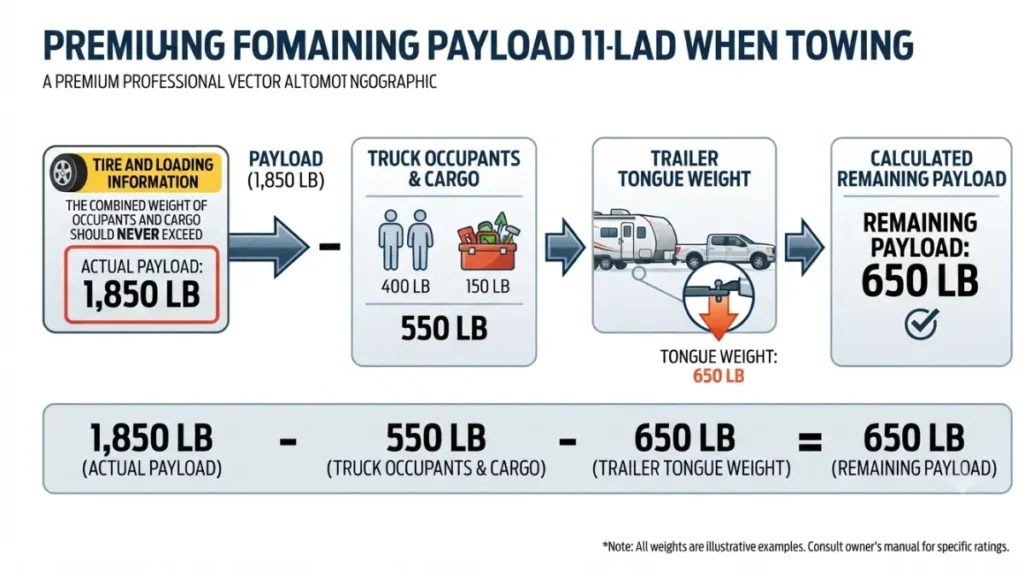
Start with the placard figure. Subtract occupants, cab and bed cargo, the ball mount and any weight-distribution hardware, then 10% of your loaded trailer weight. What remains is your margin — and the payload and tongue weight calculator runs it for you.
🔍 What This Spec Means: A weight-distribution hitch does not add payload. The hardware itself sits on the ball mount and counts against the same figure you started with.
Published payload by engine, and the truck each figure belongs to
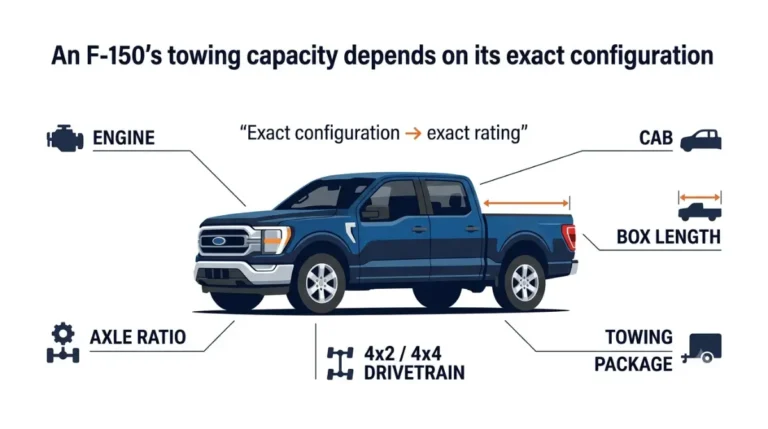
Ford publishes an available maximum payload per engine. For most engines it does not publish, in that table, which cab, bed, drivetrain or package earns the figure.
The 2026 figures as Ford states them
| Engine | Max payload | Applies To | What It Includes |
|---|---|---|---|
| 2.7L EcoBoost V6 | 1,775 lb | 2026 MY, engine maximum | Qualifying configuration not stated in the engine table |
| 3.5L EcoBoost V6 | 2,440 lb | 2026 MY, engine maximum | Qualifying configuration not stated |
| 3.5L PowerBoost Full Hybrid V6 | 1,740 lb | 2026 MY, engine maximum | Qualifying configuration not stated |
| 5.0L Ti-VCT V8 | 2,235 lb | 2026 MY, engine maximum | 2,225 lb on SuperCrew 4×2 with Tow/Haul Package and Max Tow Axle |
| 3.5L EcoBoost H.O. | 1,405 lb | 2026 MY, Raptor only | 37″ tires |
| 5.2L Supercharged V8 | 1,410 lb | 2026 MY, Raptor R only | — |
Source: Ford 2026 F-150 Towing Guide, engine table and footnotes 3, 6, 8 and 9, rev. 03-10-26.
Why your SuperCrew 4×4 lands lower
Ford’s own footnote says maximum payload varies with accessories and configuration and directs buyers to the door-jamb label. A four-door, four-wheel-drive truck with a heavy trim carries more of its own weight before you load anything.
For the full per-configuration breakdown, see the F-150 payload capacity chart; for the rest of the build record, the F-150 specs by configuration pillar.
Your hitch has its own limit, and it’s lower than the truck’s
The factory hitch receiver carries two separate ratings, and the lower one applies unless you are running weight-distribution hardware.
Weight-carrying versus weight-distributing
| Hitch setup | Max trailer | Max tongue load | Applies To | What It Includes |
|---|---|---|---|---|
| Weight-carrying | 5,000 lb | 500 lb | 2026 F-150, factory receiver | Ball and ball mount not supplied with the truck |
| Weight-distributing | 13,500 lb | 1,400 lb | 2026 F-150, factory receiver | Requires Tow/Haul Package (53T) and optional Max Tow Axle |
Source: Ford 2026 F-150 Towing Guide, Hitch Receiver Weight Capacity chart, rev. 12-19-25.
The two receiver ratings
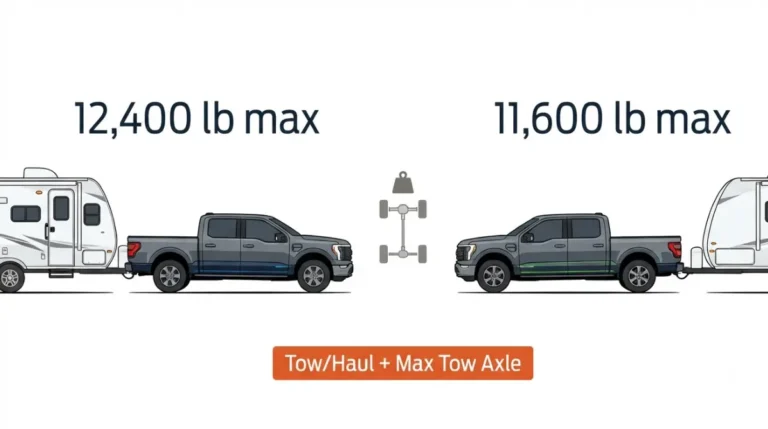
📐 On the Spec Sheet: The same guide lists a standard 2-inch receiver rated at 11,600 lb, with the Max Tow Axle adding a reinforced 2-inch receiver rated at 14,000 lb. It also instructs that trailer weight must not exceed 5,000 lb without a weight-distribution system, and notes the limited warranty may be voided if required equipment is absent.
🚫 Fits But Shouldn’t: A 2-inch receiver physically accepts a ball mount stamped far above 500 lb of tongue load. Nothing about the fit signals the weight-carrying ceiling, and the proving specification is the separate weight-carrying column above — 5,000 lb of trailer and 500 lb of tongue, whatever the truck’s tow rating says.
Engine-by-engine tow figures sit in the F-150 towing capacity by engine chart, and the receiver ratings above are from Ford’s 2026 F-150 towing guide.
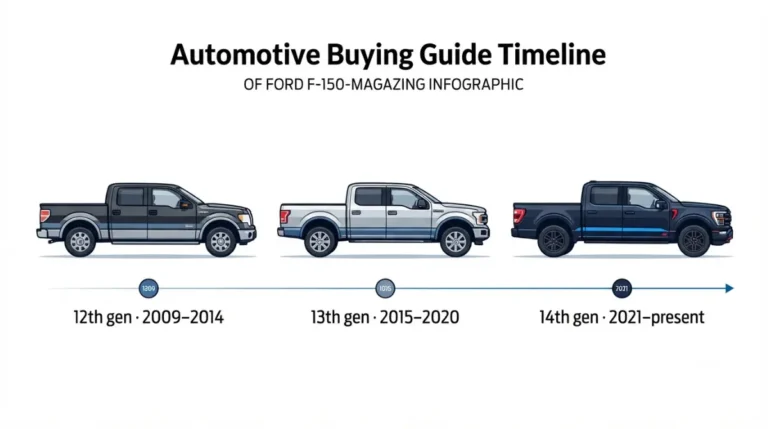
What changed between the 2021–2023 trucks and the current ones
If you researched an F-150 a few years ago, the capacity figures in your head are no longer the ones Ford publishes.
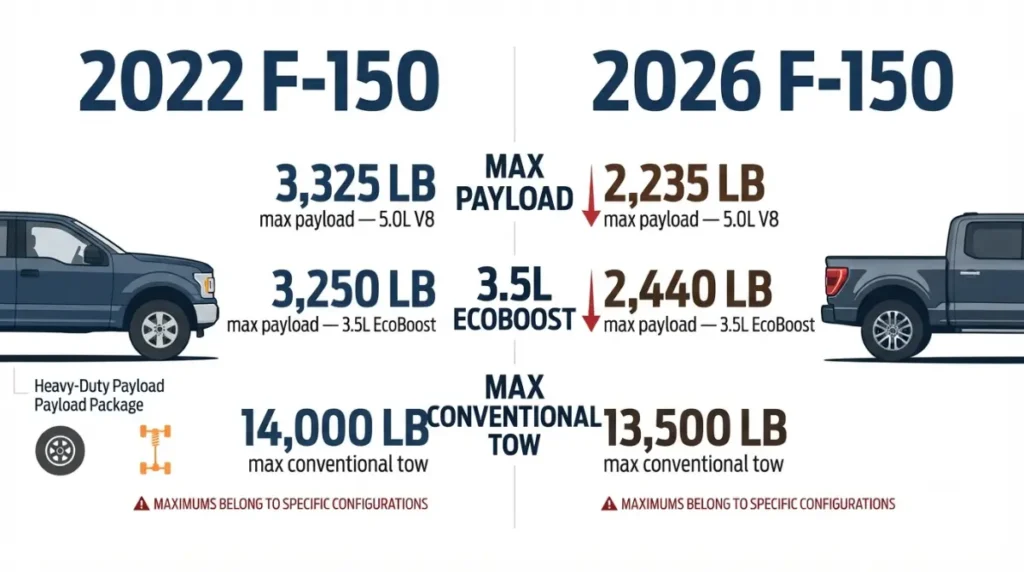
The Heavy-Duty Payload Package, and where it went
| Figure | 2022 guide | 2026 guide | Applies To | What It Includes |
|---|---|---|---|---|
| Max payload, 5.0L V8 | 3,325 lb | 2,235 lb | Engine maximum | 2022 figure: Regular Cab 8′ box 4×2 with Max Trailer Tow and HDPP (627) |
| Max payload, 3.5L EcoBoost | 3,250 lb | 2,440 lb | Engine maximum | 2022 figure requires the same package pairing |
| Max conventional tow | 14,000 lb | 13,500 lb | Best-case configuration | 2022: SuperCab 8′ box 4×2 or SuperCrew 4×2 with Max Trailer Tow |
Sources: Ford 2022 RV & Trailer Towing Guide, F-150 engine table and footnotes; Ford 2026 F-150 Towing Guide engine table.
What moved between 2025 and 2026
📐 On the Spec Sheet: Ford’s 2022 guide lists the Heavy-Duty Payload Package (627) as raising GVWR to 7,850 lb on XL and XLT, with LT275/65R18C tires, upgraded springs and a 9.75-inch gearset with a 3.73 electronic-locking axle. The 2026 guide’s package list does not carry it. Between the 2025 and 2026 guides, the weight-distributing maximum tongue load moved from 1,350 lb to 1,400 lb.
Cross-check any older figure against Ford’s 2022 towing guide and the 2025 edition rather than a summary.
Combinations that look fine on paper
Each of these uses figures that are individually correct and still produces a wrong answer.
The two maximums that belong to two different trucks
🚫 Fits But Shouldn’t: Pairing 2,440 lb of payload with 13,500 lb of towing. Ford’s engine-table note settles it — payload and towing are independent attributes that may not be achieved simultaneously, and the 13,500 lb figure carries a Tow/Haul Package and Max Tow Axle footnote the payload figure does not.
The hybrid and the travel trailer
The 3.5L PowerBoost carries the lowest published payload of the non-Raptor engines at 1,740 lb for 2026. A 7,000 lb loaded trailer demands 700 lb of that at Ford’s 10% figure, before passengers.
Drivetrain choice moves the same figure — see 4×4 versus 4×2 towing.
⚠️ Watch Out: Ford’s 2026 guide instructs reducing gross vehicle weight and gross combination weight by 2% per 1,000 ft of elevation, and caps trailer frontal area at 55 sq ft for tow ratings of 7,700 lb or less and 65 sq ft above that. A tall travel trailer can exceed the frontal-area limit while sitting comfortably under every weight figure. Check both before you commit to a trailer.
Where to check every one of these numbers yourself
Two labels in the driver’s door opening settle everything above for your specific truck.
The two labels, and the axle code
✅ Do This: Read the line that begins “The combined weight of occupants and cargo should never exceed” off the Tire and Loading Information placard — that is your payload, not the engine maximum. Then read GVWR and rear GAWR off the Safety Compliance Certification Label, and the two-digit axle code below its barcode: 15 is 3.15, 27 or L3 is 3.31, 19 or L9 is 3.55, L6 is 3.73, L4 is 4.10.
That placard wording is required by the federal placard requirement under FMVSS 110. NHTSA’s interpretation also confirms that a dealer installing extra equipment must replace the placard when the stated figure is no longer accurate.
F-150 payload and tongue weight questions
1. Does tongue weight count against payload on an F-150?
Yes. Ford instructs that payload must cover tongue load plus passengers and cargo. Confirm your figure on the door-jamb placard.
2. What is the maximum tongue weight on a 2026 F-150?
500 lb with a weight-carrying hitch, 1,400 lb with weight-distribution. Check the label on your own receiver.
3. Why is my F-150 payload lower than 2,440 lb?
That is an engine maximum for a best-case configuration. Cab, bed, drivetrain, trim and accessories all reduce it. Read your placard.
4. Where is the payload sticker on an F-150?
On the Tire and Loading Information placard on the driver’s-side B-pillar, required by FMVSS 110 to state occupant and cargo weight.
5. Do I need a weight-distributing hitch?
Ford instructs that trailer weight must not exceed 5,000 lb without a weight-distribution system. Verify your trailer’s loaded weight on a scale.
6. Can an F-150 tow 13,500 lb and carry 2,440 lb?
No. Ford states payload and towing are independent attributes that may not be achieved simultaneously. Verify both figures for your build.
7. Which 2026 F-150 engine has the highest published payload?
The 3.5L EcoBoost V6, at 2,440 lb as an engine maximum. Your truck’s actual figure is on its placard.
8. Is the PowerBoost a poor choice for a travel trailer?
It carries the lowest non-Raptor published payload for 2026, at 1,740 lb. Check tongue weight against your placard figure.
9. Did the F-150 lose payload after 2023?
Ford’s 2022 guide published 3,325 lb; the 2026 guide publishes 2,235 lb for the same engine. Verify by model year.
10. What is the 10% tongue weight rule?
Ford’s F-150 guides state conventional tongue load should be 10% of total loaded trailer weight. Confirm the loaded weight on a scale.
Before you order or hitch up
Pick your trailer weight first, take 10% of it, and subtract that from the placard figure on the actual truck — not from an engine maximum. If the remainder will not cover your passengers, your gear and the hitch hardware, the configuration is wrong for that trailer, not marginal for it. Read both door-jamb labels before you sign anything.
One Comment