The Fifth Wheel Mistake on a 5.5 Bed F-150 SuperCrew
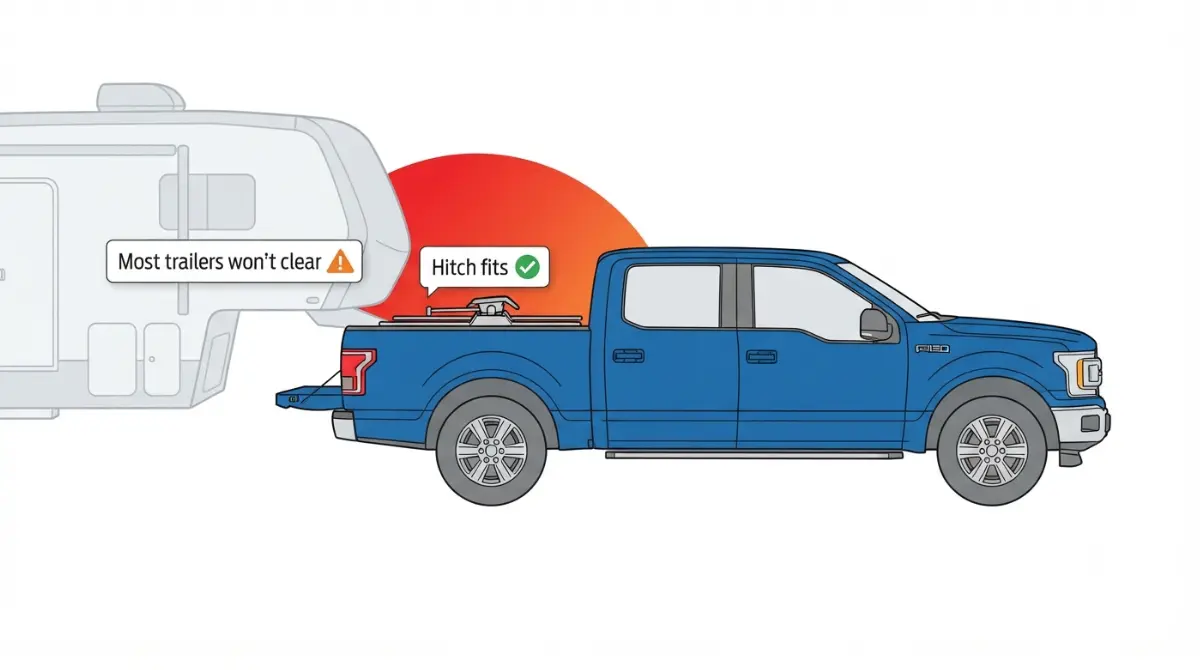
Table of Contents
Can a 5.5-ft bed F-150 tow a fifth wheel?
Ford’s answer is yes to the hitch, and mostly no to the trailer.
What Ford’s towing guide actually says
Ford’s 2026 F-150 towing guide says a 5.5-foot box accepts a fifth-wheel hitch, but most fifth-wheel trailer designs aren’t compatible with it. The 2024 and 2025 guides carry the same note. The limit isn’t the hitch. It’s whether the trailer clears the cab in a turn.
Who this answer changes things for
- Shopping for a trailer: start with the payload math below.
- Choosing between boxes: jump to the 5.5 vs 6.5-ft comparison.
- Already own a 5.5-ft SuperCrew: go straight to where your truck’s limits are printed.
ℹ️ Safety Note: F-150 fifth-wheel ratings change with cab, wheelbase, engine, axle ratio and packages. Exceeding one affects braking and stability, not just performance. This page gives no pounds figure for that reason, so verify against Ford’s guide for your model year and your truck’s labels before hitching anything.
📍 Check your own vehicle first: Specifications vary by build date, package and market, and two trucks with the same badge can be built differently. Before you buy anything based on this page, confirm against the Safety Compliance Certification Label (left front door lock facing or latch pillar), the doorjamb payload label, and your VIN build sheet. If your vehicle disagrees with this page, your vehicle is right.
Why the hitch fits but most fifth wheels don’t
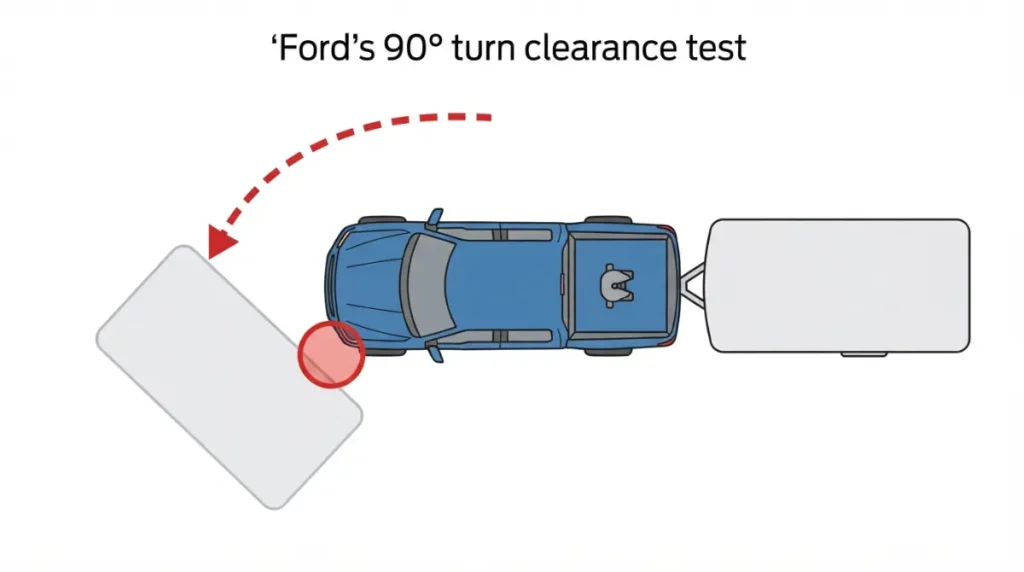
A fifth wheel pivots over the truck bed, so its front corners swing toward the cab as you turn.
The 90-degree turn test Ford uses
Ford’s RV and trailer towing guide says shorter boxes, including the F-150’s 5.5′ and 6.5′, give less cab clearance than long boxes. Ford requires the combination to clear the cab in turns up to and including 90 degrees; otherwise the trailer can hit the cab during tight, low-speed turns.
🚫 Fits But Shouldn’t: The hitch installs in a 5.5-ft box, per Ford. What goes wrong is trailer-to-cab contact in tight turns. What settles it is Ford’s 90-degree clearance requirement, and Ford’s note that most trailer designs aren’t compatible with this box.
Pin-box design and trailer width
Ford doesn’t publish which trailer designs clear a 5.5-ft box. That half of the answer comes from the trailer maker’s pin-box specification. Ford also offers its factory fifth-wheel hitch prep package on Super Duty only, so any F-150 fifth-wheel mount is aftermarket.
✅ Do This: Before buying a trailer, ask its manufacturer in writing: “Is this pin box and trailer width approved for a 5.5-ft-box truck through a 90-degree turn?”
Which Ford towing column is your truck?
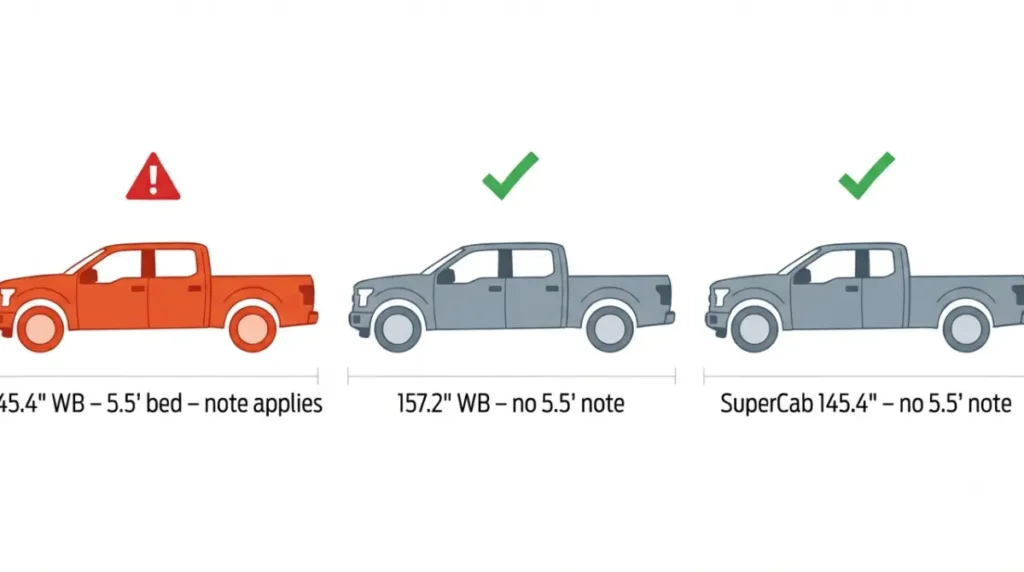
There’s no single F-150 fifth-wheel rating. Ford rates each column separately, and the 5.5-ft note sits in specific columns only.
SuperCrew 145.4″ vs SuperCab 145.4″
Both cabs share a 145.4-inch wheelbase in Ford’s tables. Only the SuperCrew columns carry the 5.5-ft note.
| Configuration | Applies To | 5.5-ft note in 5th-wheel table? | What It Includes |
|---|---|---|---|
| SuperCrew 4×2, 145.4″ WB | 2024, 2026 | Yes | “Most designs not compatible” |
| SuperCrew 4×4, 145.4″ WB | 2024, 2026 | Yes | “Most designs not compatible” |
| SuperCrew 4×4, 157.2″ WB | 2024, 2026 | No | Rated column, no 5.5-ft note |
| SuperCab 4×2/4×4, 145.4″ WB | 2024, 2026 | No | Rated column, no 5.5-ft note |
| Raptor | 2024, 2026 | Not recommended | No 5th-wheel towing |
| Lightning | 2024 | Not recommended | No 5th-wheel towing |
Source: Ford 2024 RV & Trailer Towing Guide, F-150 5th-wheel/gooseneck selector; Ford 2026 F-150 Towing Guide. Pounds ratings are left out on purpose, so read your row directly from the guide.
Conventional vs 5th-wheel tables
Ford prints conventional and fifth-wheel/gooseneck ratings in separate tables, so use only the fifth-wheel one. Some higher-GCWR rows require the Tow/Haul Package (53T) plus Max Tow Axle; see what the Tow/Haul Package adds versus the Max Tow Axle. Every cab and engine combination is in our F-150 towing specs by configuration.
Trims Ford excludes
Ford lists fifth-wheel towing as not recommended for Raptor and Lightning in 2024, and for Raptor in 2026. Every F-150 fifth-wheel application also carries a 75 sq ft trailer frontal-area limit.
The payload math a fifth wheel puts on an F-150
A fifth wheel’s pin load sits in the bed, so it comes out of payload first.
Ford’s 15% king-pin planning figure
Ford plans king pin load at 15% of loaded trailer weight. That load, plus passengers and cargo, can’t push the truck past its rear GAWR or GVWR, and the combined weight can’t exceed GCWR. Read more on how payload and tongue weight interact on an F-150.
What Ford’s rating leaves out
Ford’s maximum trailer weights assume no cargo and a 150-lb driver and passenger. The weight of options, extra passengers, cargo and the hitch must be deducted.
A worked example
Take a hypothetical trailer that weighs 8,000 lb loaded:
- 8,000 × 0.15 = 1,200 lb planning pin load.
- Add the hitch weight (from the hitch maker’s documentation), plus passengers and cargo.
- Compare that total with the payload on your doorjamb label.
- Confirm the certification label’s rear GAWR and GVWR still hold.
⚠️ Watch Out: A trailer under the tow rating can still overload the truck if the pin load uses up payload first. If you don’t know the loaded weight, use the trailer’s GVWR, which is the most it’s rated to weigh loaded.
Where to find your F-150’s real limits
Your truck’s labels outrank any brochure maximum.
The certification label on the door
Ford says GVWR and rear GAWR are printed on the Safety Compliance Certification Label, on the left front door lock facing or door latch post pillar.
The payload label
Ford points owners to the doorjamb label for a specific truck’s carrying capacity. Compare yours with the F-150 payload capacity chart.
Decoding the axle code
Below the bar code is the word AXLE and a two-digit code; for example, L6 means a 3.73 electronic-locking axle, and 19 means a 3.55 non-limited-slip axle. That code tells you which axle-ratio row to read.
5.5 vs 6.5-ft box if a fifth wheel is the plan
Ford treats both F-150 boxes as short, but only one carries the compatibility warning.
What Ford’s guide says about both boxes
Ford’s 2025 guide groups the 5.5-ft and 6.5-ft F-150 boxes as shorter boxes with less cab clearance than long boxes. The “most designs not compatible” note names the 5.5-ft box specifically. A 6.5-ft box removes that note, but it doesn’t remove the 90-degree check.
When a Super Duty is the honest answer
Ford’s Super Duty fifth-wheel/gooseneck prep package includes bed attachment points and an under-bed frame crossmember. If your pin load won’t fit your F-150’s door-label payload, a longer box won’t change that math.
If you still want a fifth wheel on a 5.5-ft box
Aftermarket products exist that aim to add turning clearance. None was tested or evaluated here.
Sliding hitches and pivot pin boxes, in general terms
These products are designed to add clearance by changing where the trailer pivots. They change geometry only, not payload, rear GAWR, GCWR or Ford’s rating. The bumper receiver is a separate rating; see F-150 hitch receiver rating vs tow rating.
What a hitch installer must confirm
✅ Do This: Ask the installer for three things:
- The hitch’s rated capacity, and its mounting documentation for your model year.
- The trailer maker’s written pin-box approval for a 5.5-ft box.
- Tailgate clearance. Ford lists the F-150 4×4’s maximum tailgate height as 58.3 inches at base curb weight, and it varies with configuration and tires.
FAQ
1. Can a 5.5 bed F-150 tow a fifth wheel?
Ford says a 5.5 bed F-150 accepts a fifth-wheel hitch, but most fifth-wheel trailer designs aren’t compatible with it. Check Ford’s guide for your year.
2. Why don’t most fifth wheels work with a 5.5-ft box?
A 5.5-ft box leaves less cab clearance, and Ford requires fifth-wheel trailers to clear the cab in turns up to 90 degrees.
3. What is the F-150’s fifth-wheel towing capacity?
There’s no single F-150 fifth-wheel towing capacity; Ford rates each cab, wheelbase, engine and axle combination separately. Find your column using your axle code.
4. How much fifth-wheel pin weight should I plan for?
Ford plans fifth-wheel pin weight at 15% of loaded trailer weight, so an 8,000-lb trailer means about 1,200 lb. Compare with your payload label.
5. Does Ford’s towing rating include the hitch and passengers?
No. Ford’s towing rating assumes no cargo and a 150-lb driver and passenger; subtract the hitch, extra passengers and cargo.
6. Where is my F-150’s payload number?
Your F-150’s payload number is on the doorjamb label; GVWR and rear GAWR are on the certification label.
7. Can an F-150 Raptor tow a fifth wheel?
Ford lists fifth-wheel towing as not recommended for the F-150 Raptor in its 2024 and 2026 towing guides.
8. Does Ford offer fifth-wheel prep on the F-150?
No. Ford offers factory fifth-wheel prep on Super Duty only, so any F-150 fifth-wheel hitch mount is aftermarket.
9. Does a 6.5-ft box avoid fifth-wheel cab contact?
Not automatically. Ford still classes the 6.5-ft box as short, so fifth-wheel cab clearance must still pass the 90-degree check.
10. Does a sliding hitch increase F-150 towing capacity?
No. A sliding hitch changes turning geometry only; it doesn’t raise F-150 towing capacity, payload, rear GAWR or GCWR. Confirm ratings on your labels.
The short version before you buy
A 5.5-ft SuperCrew F-150 takes a fifth-wheel hitch, but Ford says most trailers won’t work with it. Before spending anything, find your column in Ford’s guide for your model year, and run the 15% pin-load math against your doorjamb label. Then get the trailer maker’s pin-box approval in writing.