PowerBoost vs 3.5 EcoBoost: Tow and Payload by Drivetrain

PowerBoost 4x4s rate 800 lb below the 4×2 on a 2026 F-150 SuperCrew with Max Tow Axle; the 3.5 EcoBoost’s top 4×4 row sits 200 lb above its 4×2.
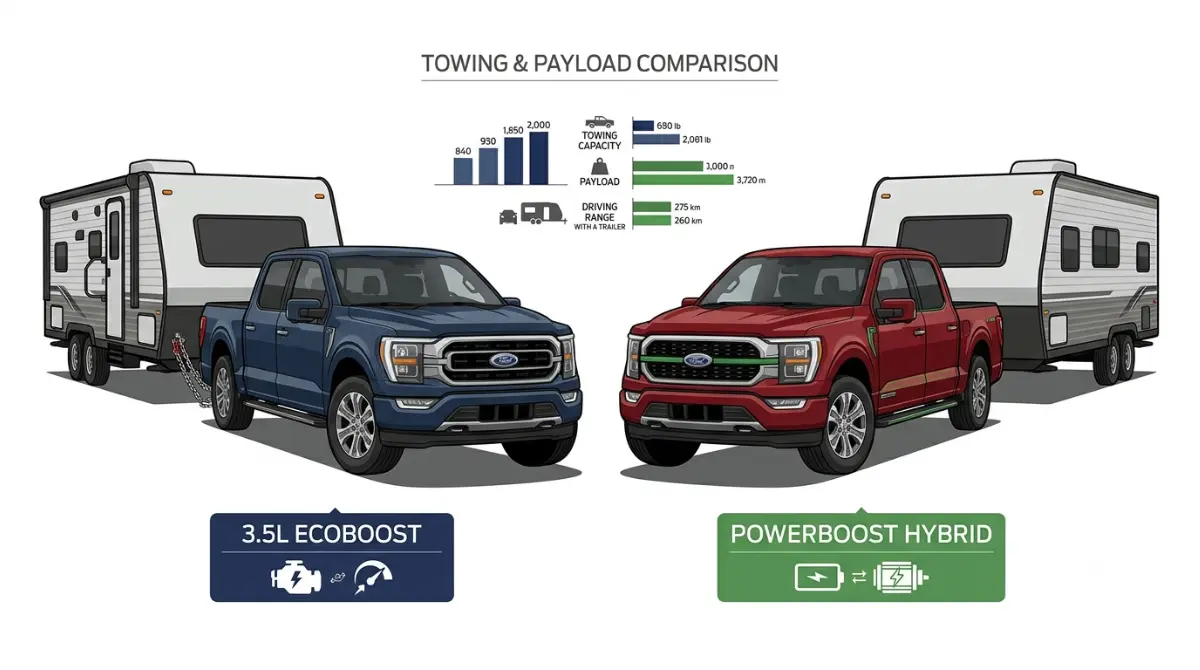
Table of Contents
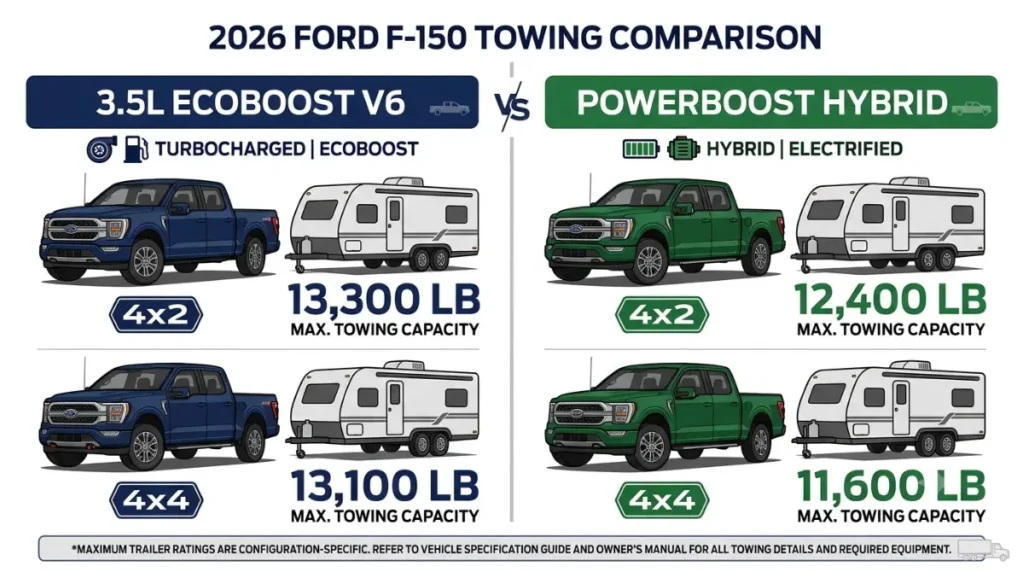
On a 2026 F-150 SuperCrew with the Tow/Haul Package (53T) and the Max Tow Axle, the 3.5L EcoBoost is rated to tow 900 lb more than the PowerBoost hybrid as a 4×2, and 1,500 to 2,000 lb more as a 4×4, depending on box length. On the same drivetrain it also carries 395 to 435 lb more maximum payload.
Those gaps belong to matched builds. Change the box length or the drivetrain on one side of the comparison and the gap changes size.
The 2026 ratings on the same SuperCrew build
Matched build for build, Ford’s 2026 towing selector puts both engines on the same cab, drivetrain, wheelbase and tow equipment. The EcoBoost’s top rows use the 3.55 electronic-locking axle; the hybrid’s use the 3.73.
| Applies to (2026 SuperCrew, 53T + Max Tow Axle) | 3.5L EcoBoost | PowerBoost | Gap | GCWR, EcoBoost / PowerBoost |
|---|---|---|---|---|
| 4×2, 145.4-in wheelbase, 5.5-ft box | 13,300 lb | 12,400 lb | 900 lb | 19,300 / 18,400 lb |
| 4×4, 145.4-in wheelbase, 5.5-ft box | 13,100 lb | 11,600 lb | 1,500 lb | 19,400 / 18,400 lb |
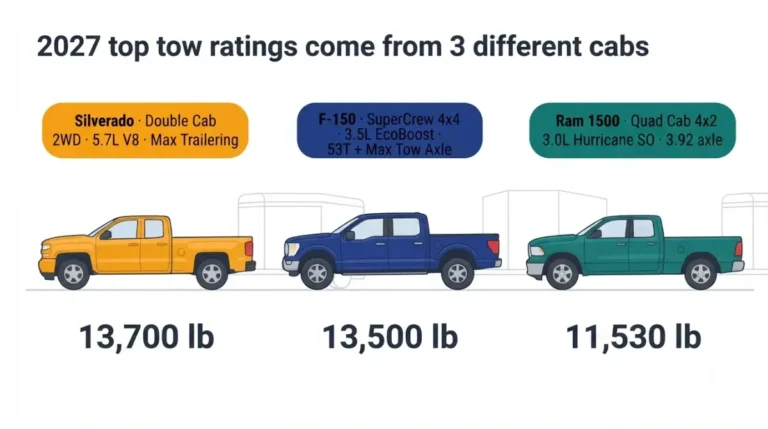
| 4×4, 157.2-in wheelbase, 6.5-ft box | 13,500 lb | 11,500 lb | 2,000 lb | 19,400 / 18,400 lb |
Source: Ford 2026 F-150 Towing Guide, conventional towing selectors for the F-150 pickup and F-150 Hybrid, revised March 10, 2026. Ford marks the hybrid 4×2 columns “Available spring 2026.” Ratings are maximum loaded trailer weight, calculated with the SAE J2807 method.
Payload follows the same order.
| Applies to (2026) | 3.5L EcoBoost | PowerBoost | Gap |
|---|---|---|---|
| 4×2, maximum payload | 2,440 lb | 2,045 lb | 395 lb |
| 4×4, maximum payload | 2,175 lb | 1,740 lb | 435 lb |
Source: Ford 2026 F-150 Technical Specifications, version 1.1, March 31, 2026. The payload for one specific truck is printed on the Tire and Loading Information placard on the driver’s door jamb.
Dealer pages often set 13,500 lb against 11,600 lb as the SuperCrew 4×4 comparison. Those two figures come from different boxes: 13,500 lb is the EcoBoost with the 6.5-foot box, and 11,600 lb is the hybrid with the 5.5-foot box. The rows for every other F-150 engine sit in the F-150 configuration tables for 2021–2026.
Why the hybrid gives up more as a 4×4
Torque is the figure that misleads here. Ford’s 2026 specifications list 570 lb-ft for the PowerBoost and 500 lb-ft for the 3.5L EcoBoost, yet the hybrid’s tow rating is lower on every matched build.
The ceiling comes from GCWR, the most the loaded truck and loaded trailer can weigh together. The hybrid’s highest GCWR is 18,400 lb. The EcoBoost’s is 19,300 lb as a 4×2 and 19,400 lb as a 4×4.
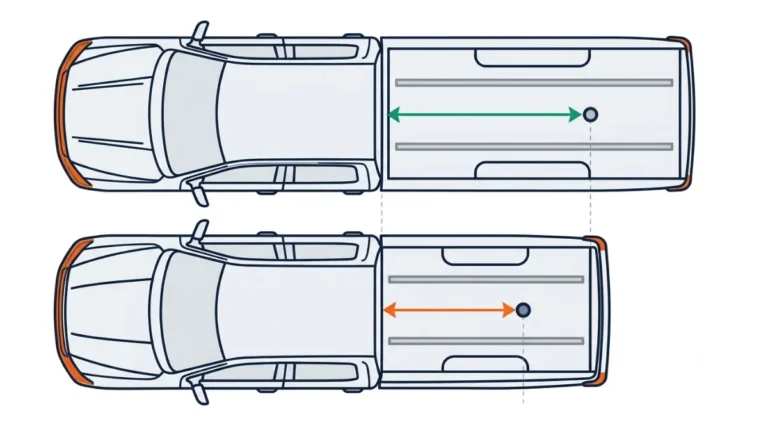
Drivetrain and box length then move the two engines in opposite directions. On the EcoBoost, the 4×4 with the 6.5-foot box holds the top rating, 200 lb above the 4×2. On the hybrid the 4×2 holds it, and the 4×4 gives up 800 lb with the 5.5-foot box and 900 lb on the longer box.
A 4×4 hybrid buyer can’t borrow the 4×2’s 12,400-lb figure. The hybrid’s lower rows, including trucks ordered without the Max Tow Axle, are set out in the F-150 hybrid tow ratings by drivetrain, wheelbase and axle.
How much payload is left after the tongue weight?
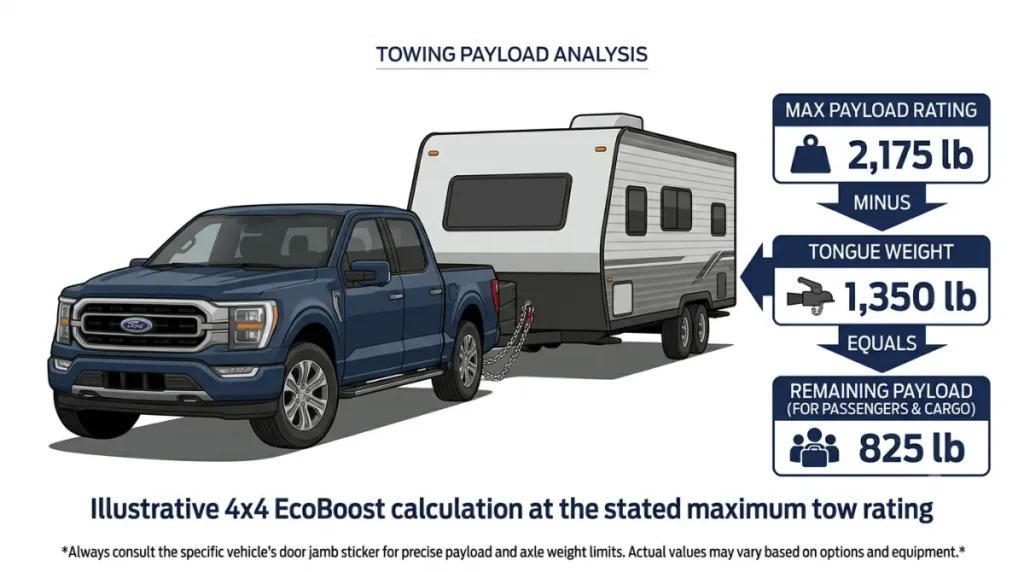
At Ford’s 10 percent tongue-load guideline, a 12,400-lb trailer puts 1,240 lb on the hitch of a hybrid 4×2. That load counts against payload before anyone sits in the cab.
| Applies to (2026, at the build’s top tow rating) | Maximum payload | Tongue load at 10% | Left for people and cargo |
|---|---|---|---|
| EcoBoost 4×2, 13,300-lb trailer | 2,440 lb | 1,330 lb | 1,110 lb |
| EcoBoost 4×4, 6.5-ft box, 13,500-lb trailer | 2,175 lb | 1,350 lb | 825 lb |
| PowerBoost 4×2, 12,400-lb trailer | 2,045 lb | 1,240 lb | 805 lb |
| PowerBoost 4×4, 5.5-ft box, 11,600-lb trailer | 1,740 lb | 1,160 lb | 580 lb |
Worked out from the payload figures in Ford’s 2026 Technical Specifications and the 10 percent tongue-load guideline in the 2026 Towing Guide.
The last column is a ceiling. Ford’s specifications treat maximum payload and maximum towing as independent figures that one truck doesn’t necessarily reach together, and trim level and options lower the payload printed on each truck.
The towing guide adds a limit of its own. Tongue load plus passengers and cargo cannot take the truck past its rear GAWR or GVWR, both printed on the Safety Compliance Certification Label on the driver’s door. How each pound of tongue weight is counted is laid out in F-150 payload and tongue weight.
Before you hitch: Subtract your trailer’s tongue weight from the payload on the Tire and Loading Information placard of the truck you are buying. If what remains won’t cover your passengers, hitch hardware and bed cargo, have a hitch installer weigh the loaded truck and trailer against the GVWR and rear GAWR on the door label.
PowerBoost vs 3.5 EcoBoost for the trailer you tow
If your loaded trailer weighs more than 10,800 lb, the hybrid needs both the Tow/Haul Package (53T) and the Max Tow Axle. A gas F-150 needs that pair only above 11,600 lb. Ford’s 2026 towing guide warns that the New Vehicle Limited Warranty “may be voided” if you tow without the required equipment.
The closer your trailer sits to 11,600 lb, the more the EcoBoost’s extra GCWR and payload count. Ford’s 2026 selector has no hybrid 4×4 row above that figure, and at it the hybrid 4×4 has the thinnest payload margin of the four builds in the table above.
Long tows bring fuel capacity into it. Ford lists a 30.6-gallon tank for the PowerBoost and 36.0 gallons for the 3.5L EcoBoost.
The hybrid’s other draw is Pro Power Onboard, the truck’s built-in power outlets. Which output comes with which engine and package is covered in Pro Power Onboard outputs by engine and package.
Shopping a 2021–2025 truck instead
In 2021, Ford’s top ratings for both engines were higher than the 2026 figures, and each year’s guide carries its own rows.
| Model year | 3.5L EcoBoost top rating | PowerBoost top rating | Equipment for the top rows |
|---|---|---|---|
| 2021 and 2023 | 14,000 lb (SuperCab 8-ft box 4×2 or SuperCrew 4×2) | 12,700 lb | Max Trailer Tow Package (53C) on the EcoBoost rows |
| 2024–2025 | 13,500 lb (2024: SuperCrew 6.5-ft box 4×4) | 11,200 lb | Tow/Haul Package (53T) plus Max Tow Axle |
Source: Ford’s F-150 towing guide for each model year, row by row in the F-150 towing ratings by engine, axle and cab.
A dealer page or listing that quotes 11,200 lb for a PowerBoost is quoting the 2024–2025 rating, and 12,700 lb is the 2021 and 2023 figure. For a 2022 truck, read Ford’s 2022 towing guide, since its figures aren’t in this table.
Check the hitch receiver label before you sign
On the receiver itself, Ford fixes a label with the receiver’s rated capacities, and on a 2026 F-150 that label separates a Max Tow Axle truck from a standard one. Ford lists the standard 2-inch receiver at 11,600 lb and the reinforced receiver that comes with the Max Tow Axle at 14,000 lb.
The AXLE code on the door’s Safety Compliance Certification Label can’t settle it alone. Ford’s 2026 selector puts the EcoBoost’s top rows on the 3.55 electronic-locking axle, label code L9, which its lower 3.55 rows share. The hybrid’s top rows and its lower 3.73 rows share code L6. On order paperwork the two 3.55 versions carry different codes, covered in how XL9 and XL5 sit behind one label code.
Before signing, check the truck in front of you in this order:
- The window sticker or VIN build sheet, for the Tow/Haul Package (53T) and the Max Tow Axle line.
- The hitch receiver label, for the 14,000-lb rating.
- The door certification label and loading placard, for GVWR, rear GAWR and payload.
Check your own truck: If the window sticker is missing, ask the dealer to pull the build sheet by VIN and show you the Max Tow Axle line and the GCWR for that VIN before you sign.
Found this helpful? See more of our guides on Google.
Want to see our guides first on Google?